7 Days 7 Lessons #14 - Problems Edition

- Problem 1: How Do We Transition Into AGI
- Problem 2: Improving Water Scarcity Through Desalination
- Problem 3: How Can We Make The Internet More Accessible?
- Problem 4: Batteries are great, but we need to make them better
- Problem 5: Creating Fake Organs
- Problem 6: Curing Addiction
- Problem 7: Rising Wealth Inequality
I love problems. Problems are what we use to track progress. The more problems we complete, the more progress we make.
History tells us that Humans seeking problems is what has allowed us to carry out so much innovation.
The goal of this special edition of 7 Days 7 Lessons is to put our collective minds to work on some of the biggest problems facing us right now.
We waste a lot of our lives doing meaningless work, but what would happen if we spent most of our lives fixing real problems in the world?
I hope you enjoy this week's edition of 7D7L!
How Do We Transition Into AGI
How do we transition to a world where AGI does most of our work?
I'm hoping to write a short story that highlights this problem. Recently, it has really been bothering me. I don't understand how we can sustainably transition to AGI. Nothing I've watched or read from the AI frontier leaders has been able to answer this question with a good idea.
Let me provide some context.
Firstly, AGI is defined as the ability for an artificial intelligence system to complete knowledge-based work, often associated with the white-collar industry. It is also the ability to carry out learning, independently, to a high degree of accuracy.
Secondly, the success of AGI being able to complete its tasks should be as good as the success of autopilot in the aviation industry (autopilot is the best example of incredible automation and an intelligent system, with a very accurate success rate, yet still requires a select few overseers to be present).
Thirdly, white-collar jobs account for 55% of the job market.
Now, imagine yourself as the CEO of a corporation. 55% of your workforce are white-collar workers. AGI has just been achieved, and AI companies are attempting to sell you on firing nearly all your employees and replacing them with AGI agents, ones that will work 24/7 and be monitored by senior employees.
My question to you is, what do you do now?
Do you do what the AGI companies tell you to do? If you did that, it might not affect the economy, but if every company did the same, suddenly 55% of the workforce would be displaced!
How about you decide to cut only 25% of your workforce? Well, if everyone else did the same to compete with you, there would still be massive economic fallout.
Do you keep your employees or stop hiring? What happens to the newer people entering the job market? Protests would begin due to a lack of jobs, even with some people moving towards more physical labour! This could lead to governments being overthrown, and again, economic fallout eventually.
So far, I haven't heard a good answer to this problem, and I think it's a problem that will need an answer very, very soon. Demis Hassabis predicts that AGI will be here in the next 3-4 years. Dario Amodei predicts that AGI will be achieved in 1-2 years.
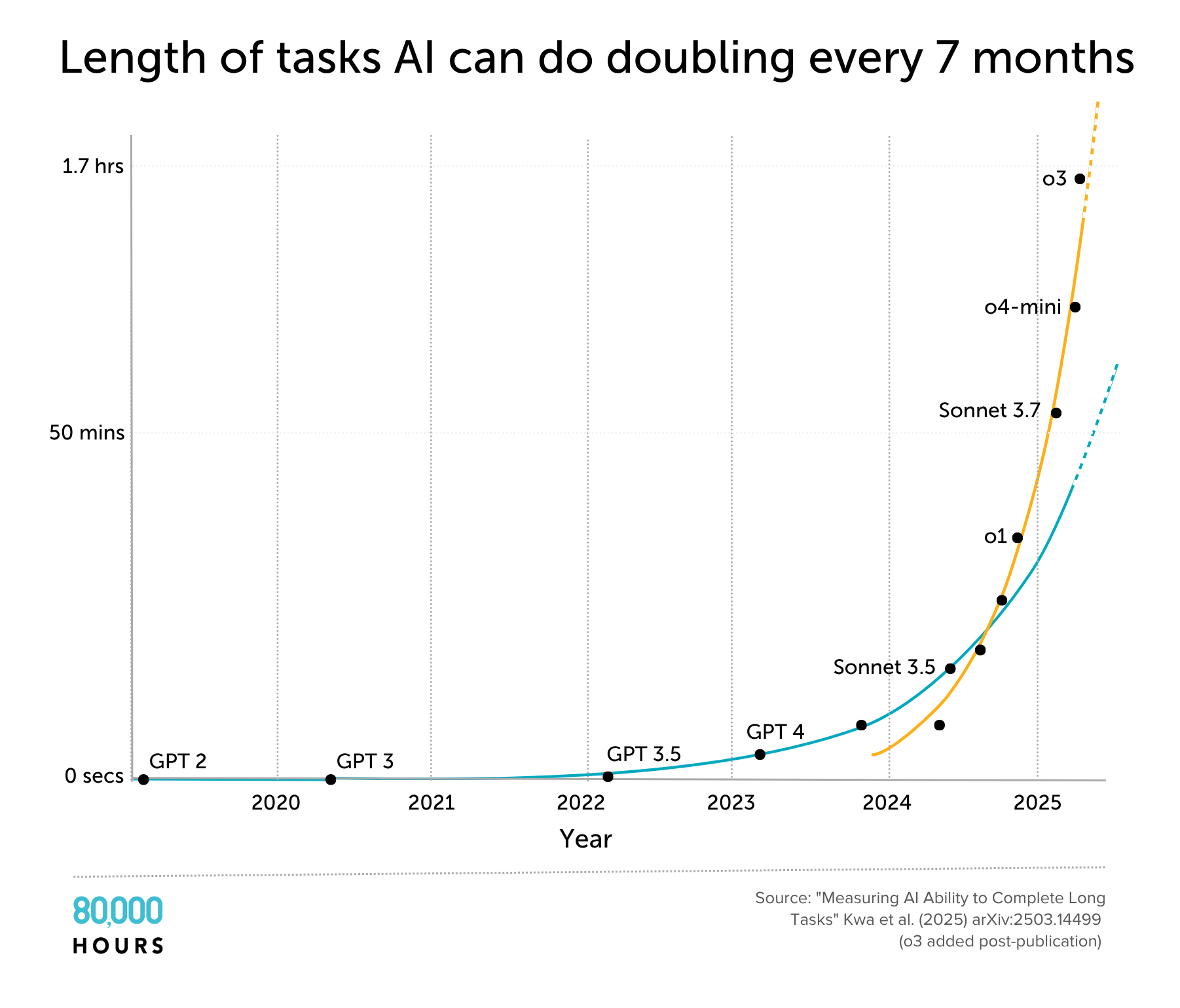
AI is improving exponentially, and the growth may not slow down.
Forecasting hasn't helped give a good estimate as to when AGI will arrive, nor has its flexible definition.
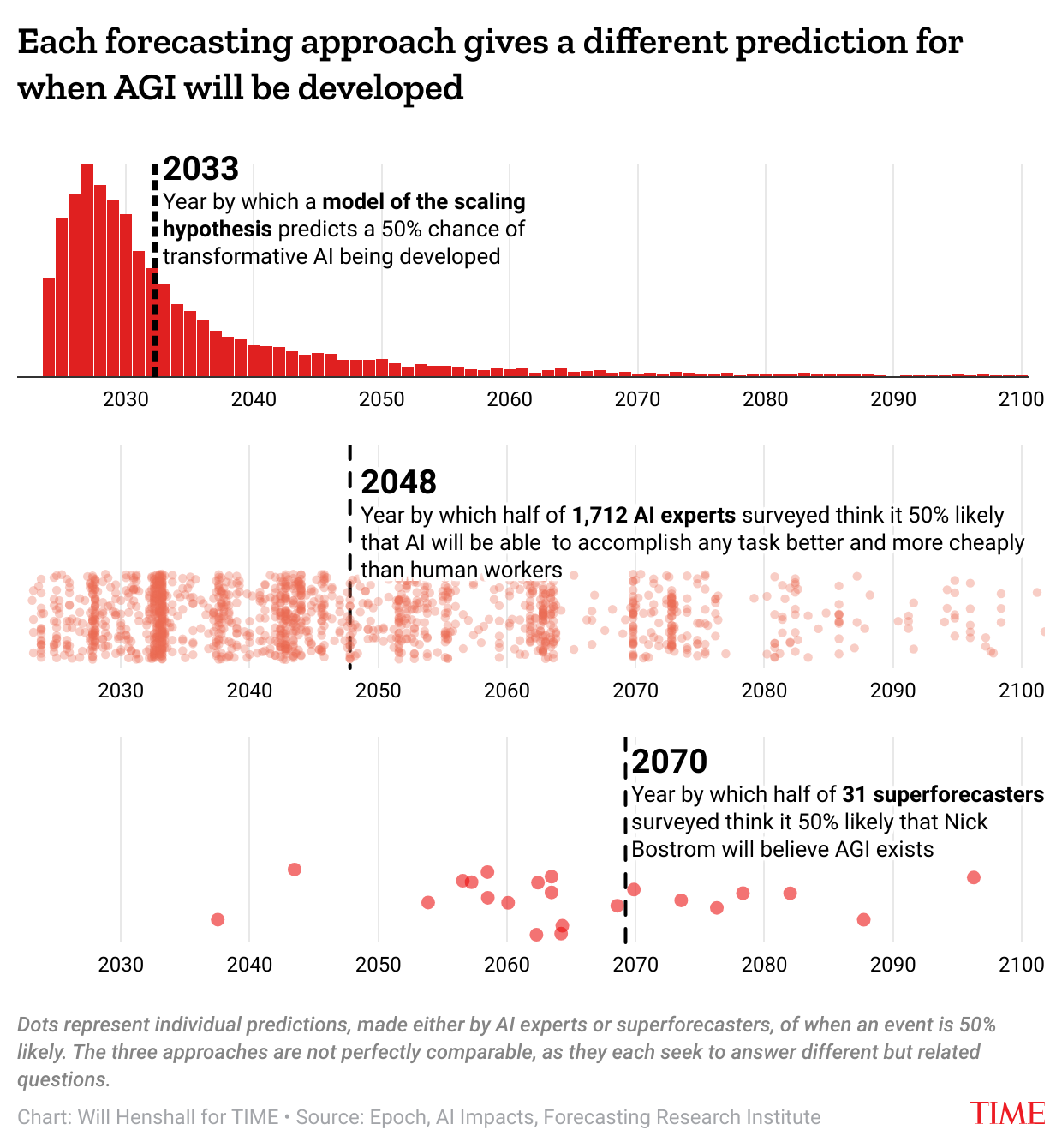
Nonetheless, I believe it is sooner than we think. I think the best case is by 2030, the worst case is by 2040 (if research must continue and the AI bubble bursts).
We've already tasted the strengths of AI, and no one is looking to stop chasing this almost godly deity.
I've only touched on some of the possible catastrophes that could arise from the creation of AGI. I mean we could not only see economic instability, and protests, but also adversaries using this technology for harm, such as giving the knowledge on how to build nuclear bombs to enemy states, allowing malicious governments to send wave after wave of attacking bots that could disrupt entire countries, and the ability to create biological weapons that only attack a small subsection of humanity.
Too many people are talking about the good of AI, and if we lived in a society driven and coordinated by good people, yes, we would be able to use it for good. But I fear that there being a small number of evil people in this world will mean this technology could be the end of us.
Improving Water Scarcity Through Desalination
2 billion people worldwide don't have access to safely managed drinking water.
Access to clean water is a massive problem in the world. 1 in 4 people worldwide still lack access to safely managed drinking water. But when you tailor that view to Africa, the number rises to ~1 in 3 people.
Africa, the Middle East and India are areas that are suffering the most from a lack of safe drinking water, but it has been improving over time.
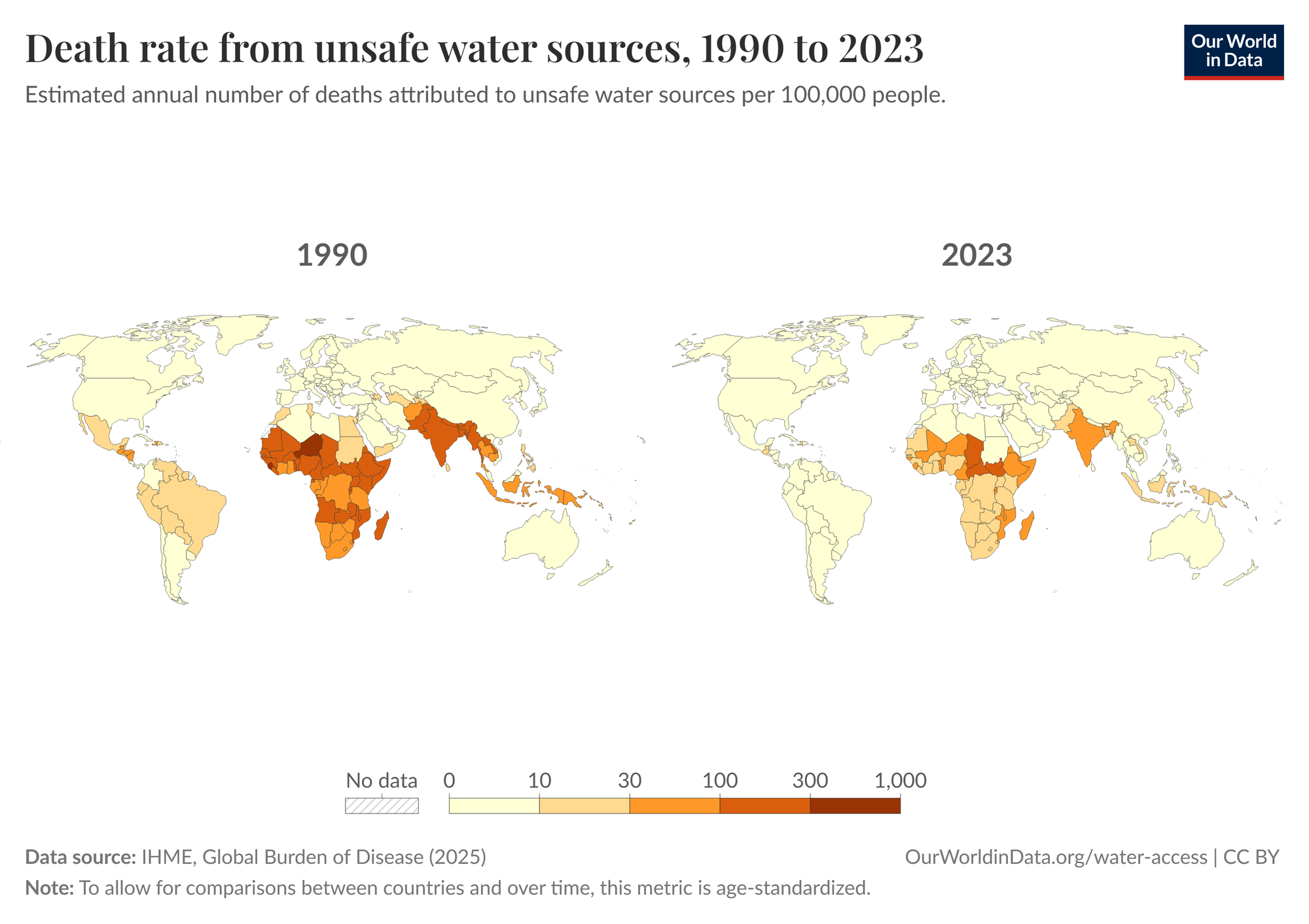
Yet although deaths may be lower, access to clean water is still not where it should be.
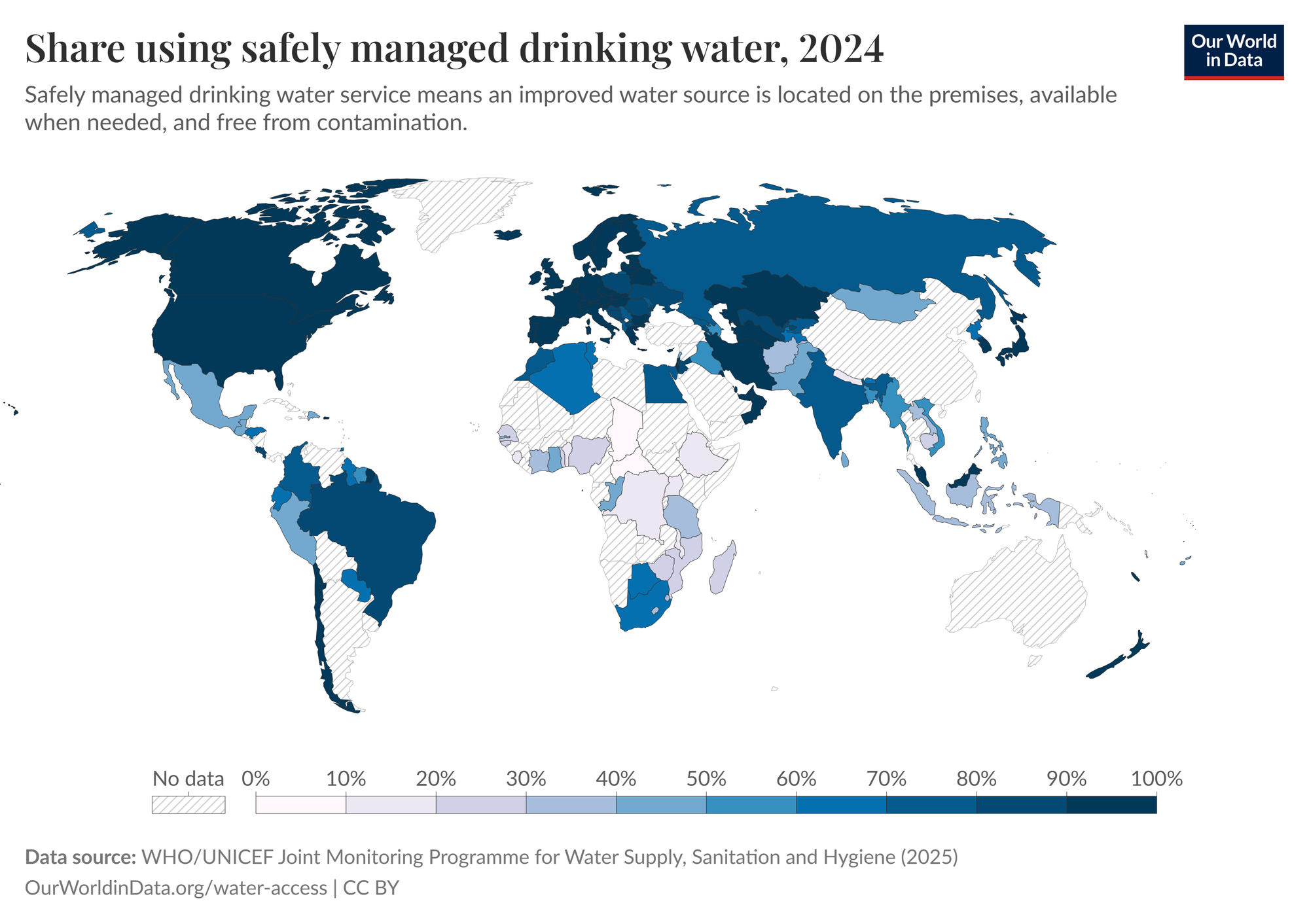
Unfortunately, data showing what countries have access to clean drinking water isn't good, but if you correlate both of the above images together, you can get an idea of where the world is regarding water scarcity.
Most Western countries have the benefit of having natural ways of generating clean water. However, this is not the case in areas such as Africa, the Middle East and Southern Asia.
In fact, other sources of water are typically used, such as digging wells to get access to deep water ravines or desalination.
I actually want to highlight desalination. If you don't know what it is, desalination is the process of removing the salt from seawater to turn it into clean drinking water. A lot of countries in the Middle East, such as Saudi Arabia, rely heavily on desalination plants to generate their drinking water.
The problem is, desalination is incredibly costly (primarily because of energy costs), and also, the waste that is produced from the process (which is called brine) is really hard to get rid of.
This is where maybe more brains could be working on this:
- Firstly, finding ways of making energy cheaper. This will probably come from renewable energy becoming more cost-efficient, especially when we think of solar panels in these very sunny countries.
- Secondly, finding ways to make brine waste removal more environmentally friendly. At the moment, it's causing a lot of damage to marine life, and this is prompting regulation to be passed to slow down the fabrication of desalination plants.
If we can tackle these two problems, we may be able to tackle the problem of water scarcity around the world.
I think it's so easy to forget that people around the world still die from a lack of safe drinking water. The quality of life is lower because they cannot consume the recommended amount of water to have a healthy body. A lot of people still walk many miles just to get access to water.
This problem is an important one to solve. I believe desalination is one of the best options for it. All we need to do is solve the high cost of desalination, and how we deal with the brine waste from the process. Maybe one day, we can even create our own water simply by combining hydrogen and oxygen to create water out of literal thin air.
How Can We Make The Internet More Accessible?
37% of the world population still doesn't have access to the internet.
The internet is an incredible piece of innovation. Although there are plenty of negatives, there are many more positives.
You can learn pretty much everything using YouTube or Online Courses. You can create anything in the digital realm thanks to programming languages and cloud computing, and even make money on the internet through investing and building products. All of this is possible without needing to leave the comfort of your home.
There's so much good that comes from the internet, and it's a shame that 32% of the world still does not have access to it.
But why is it important that the rest of the world gets access to the internet? Well, the internet is probably the greatest equaliser to have ever existed. In the US, no matter your background, you probably have access to the internet. That means you can learn, build and compete against those who had a much better start to life than you.
The internet can improve education, economic mobility, and global opportunity.
I'll give one example where the internet has significantly improved a country's people.
India in 2015 pushed for a massive rollout of digital infrastructure. They wanted to increase the number of people who had internet access. In 2015, that number was 15%. But as of 2025, that number was 70%. This massive jump has led to India becoming one of the largest economies in the world and producing very talented individuals competing on the frontier of STEM.
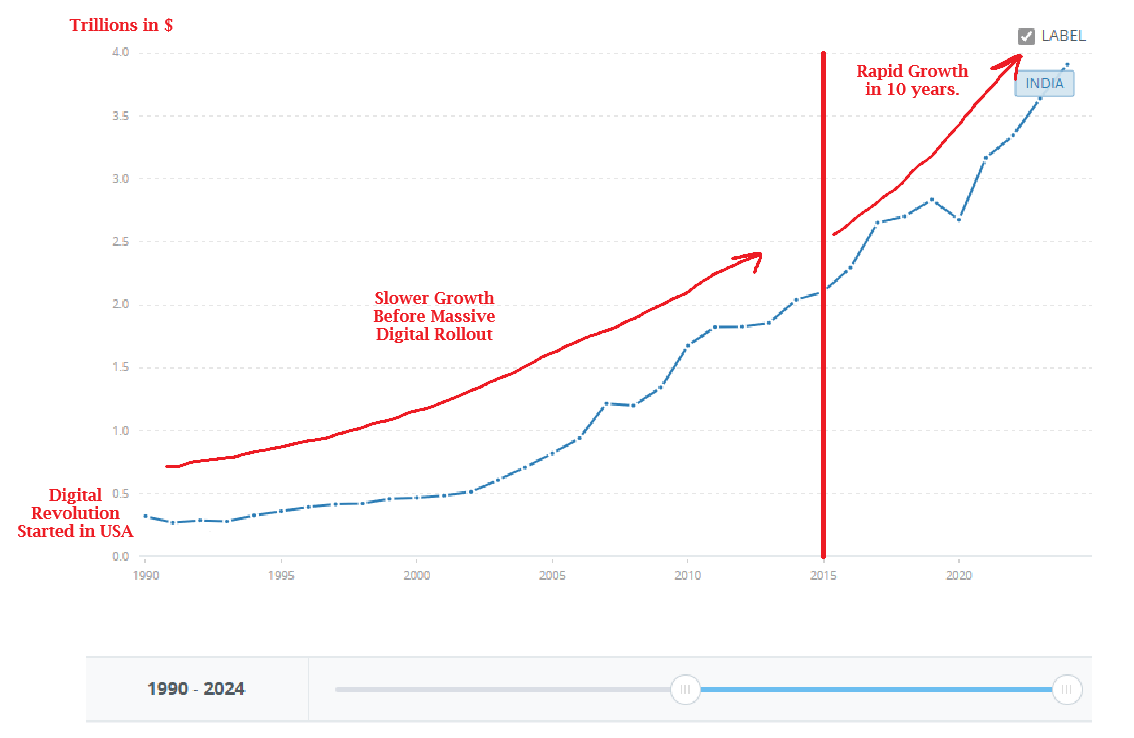
But how do we fix the problem of 32% of the world population not having access to the internet?
Well, I would like to introduce you to a company called Starlink.
Starlink provides internet using satellites, and a very fancy router called the user terminal. As a result, it does not require expensive country infrastructure to be deployed in order to provide internet access. All that is needed is a power connection, a user terminal, and a subscription to Starlink.
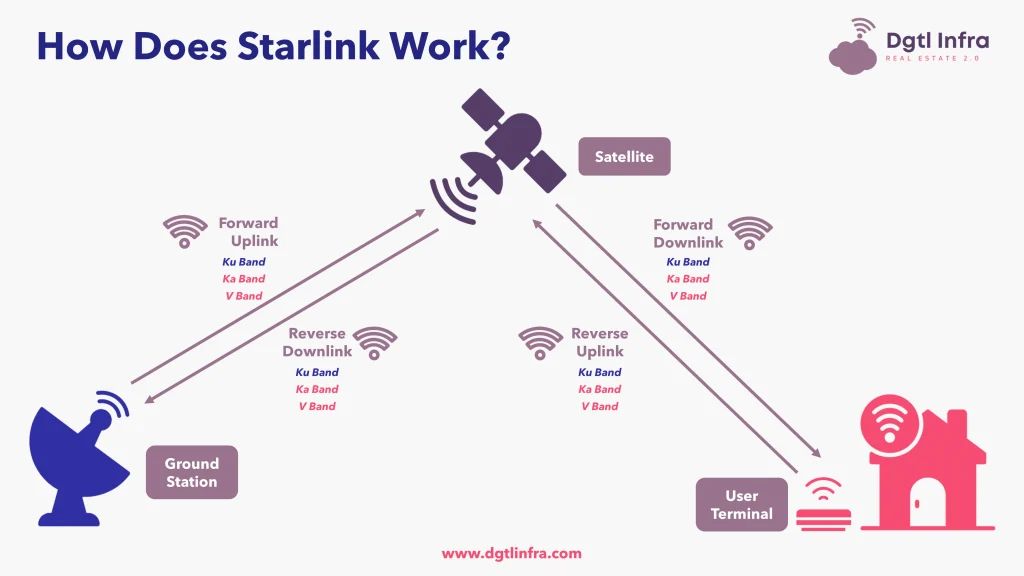
Now, that does address how we get the internet to people, but it doesn't solve the cost of doing so. The problem with Starlink is that the cost of the subscription and the hardware is still quite high in developing countries. If we look at Ghana, the cost of a Starlink Subscription is around 1/3 of a monthly salary in Ghana. That is simply out of the question for most Ghanians, and therefore, most of the developing world.
The biggest reason for this high cost is getting satellites into space. How do we solve this?
Well, it's going to require rocket science!
- Firstly, Rockets are used to get satellites into space; therefore, reducing their cost is imperative. This is how satellites get into space. As of right now, this is still quite expensive, even when using reusable rockets. Some ways of reducing the cost of space travel could be by making the rocket more compact, therefore requiring less fuel to travel, competition between rocket companies to drive supply up and therefore price down, and lastly innovating how we get things into space. Are rockets really the best way? Or are we just so used to it?
- Secondly, how can we deploy even more satellites? Could it be possible to decrease the size of satellites so that we can deploy many more of them at once? Starlink is already doing this, but how can we improve this even more?
Eventually, I do think Starlink will become much more affordable. If we do see more competition, this is almost guaranteed. When this does happen, 32% of the world population will have the chance to be connected to the internet, which will increase the number of opportunities the developing world has by an infinite amount.
I think there's been a loss of passion for space and innovation. There are a few private companies leading initiatives in this, such as Virgin Galactic and SpaceX, but we need more! Imagine a world where we could travel to other planets, where internet access was available to everyone, and where space became a new place for people to explore.
The opportunities could be vast and could lead to massive improvements in the lives of many people. It's exciting, and a real possible future.
Batteries are great, but we need to make them better
Batteries are one of the biggest reasons why renewable energy isn't making bigger leaps.
To get an idea of what I mean, let me explain how we create electricity.
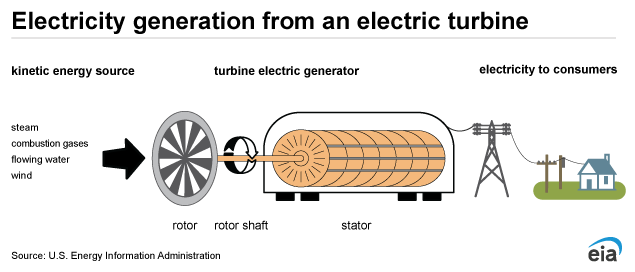
First, we have a primary energy source. Let's use coal or nuclear fission as an example. Both these examples create a lot of heat. This heat is typically used to warm up water, which turns into steam. The steam moves a rotor, which in turn charges a stator, which is what creates the electricity that goes through our power grid to our households and offices.
The question then becomes, how do we store energy we can't control, for example, solar and wind? For coal and nuclear, we simply decrease the energy generation and store it as raw materials until we need it for electricity. But you can't really store wind or sunlight. Therefore, for these cases, we need to store it as electricity, and the way to do that is by using batteries.
The problem then comes to batteries.
Storing energy in batteries is tough for a few reasons.
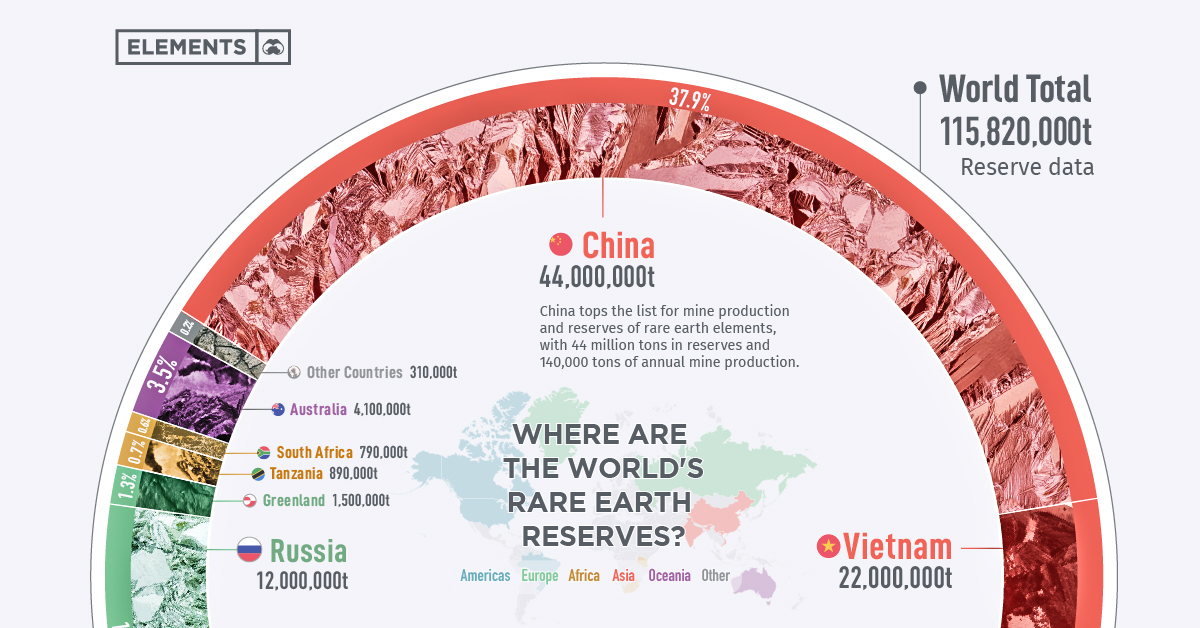
- Large-scale batteries are really expensive, and the rare-earth materials needed to create them are hard to get. Most rare-earth metals come from China (owning ~40% of the supply). The lack of competition drives up the cost, and as these rare earths become more in demand, the supply struggles to meet demand, raising the price of the good.
- Batteries don't store as much energy as fossil fuels (by footprint), and they also degrade over many charging cycles (think about your phone battery; my battery health, for example, is at 84% from when it initially started at 100%).
These two problems mean a lot of renewable energy is wasted. For example, in the UK, we produce a lot of solar energy, but we struggle to store it when most of it is generated (during the summer and midday).
That does mean it makes your electricity bills cheaper, but it would be far cheaper for you to consume it, and batteries would allow for that excess energy to be stored.
So, how do we solve this issue?
- Firstly, by making rare earth materials cheaper. Expanding mining to other countries, such as Ukraine and Australia, and having them compete with the international market.
- Secondly, by improving the technology around batteries and how they store electricity. Solid-state batteries are making massive improvements in the battery space, but even more improvements can be made.
If we want to achieve the climate change goals in the time period we've set out for, in an economical way, solving the battery problem is a massive step in the right direction.
Batteries are fundamentally needed for a digital society. The more we progress as a society, the more likely we are to need batteries. Technology will become as common as the need for water and electricity in a home or office; batteries are critical for a future where this is true.
Improving the battery landscape could help make electric vehicles more appealing, as they may be able to drive us much further than a single fuel tank could. It could even help us achieve net zero sustainably. Furthermore, as rare earth becomes mined and therefore less rare, this will drive its cost down and allow for technology to become more accessible. All of these things will ultimately benefit society.
Creating Fake Organs
Every day in the UK, 3 people die because they do not receive the organ transplant they need.
This number is significantly worse in the USA.
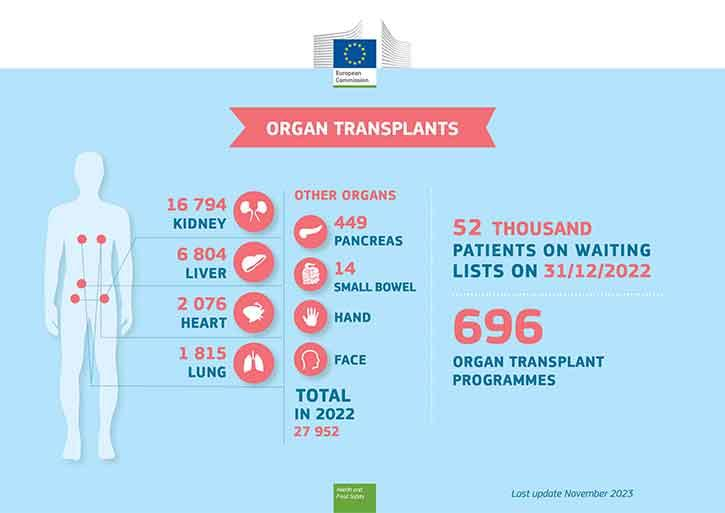
Unfortunately, organs are really hard to come across (duh...). You can retrieve them from a dead body (donors can also be alive if they are happy to donate, and they could live without it), but it has to be done really quickly once a person dies, typically within the next few hours.
From that, the supply shrinks further. The organs must be healthy, the person must have no serious medical conditions, and lastly, the person must be an organ donor.
All of these things combined mean that we have a massive backlog of organ transplants, with people needing them desperately to survive.
Kidney transplants have the highest demand.
So, how do we save thousands of people from dying every year? Well, you could argue that the promotion of becoming organ donors and the normalisation of it is a good start, but unfortunately, that has been going on for a while, and it hasn't had much success.
In 2020, a law was passed in the UK that meant you would, by default, become an organ donor. You could opt out of this, but this change actually meant those too lazy to opt in were opted in, and people too lazy to opt out became organ donors too.
This did have some success, but it is still not good enough.
Instead, the better, but certainly more challenging way is to create our own organs.
Organs are super complex machines, and being able to create one accurately is almost impossible. But maybe, if we put our collective minds to it, a few brilliant ideas could lead the way to solving this issue.
Some of the issues include the complexity of the organ itself; we need to understand something before we can make it.
Then it's dealing with immune rejection (sometimes organs are treated as hostile outsiders when brought into a new body). Is there a drug we can create to prevent this from happening? How can we create an organ that is accepted by all bodies?
Lastly, bringing more advances to 3D bioprinting technology that could be used to create organs. Unfortunately, this is still in its infancy, but if more funding and brilliant minds are put to the task, maybe we can get this problem solved.
Not only could the creation of our own organs lead to thousands of deaths per year being prevented, but we could also improve many genetic conditions people are born with such as defective hearts, lungs, etc.
The possible quality of life improvement is immense, and this is a frontier in the scientific field more people should be looking at.
Curing Addiction
Around 200 million worldwide suffer from alcohol or drug addictions.
2.2% of the world's population has a substance abuse problem. That number skyrockets when you focus on developed countries.
16.6% of adults in England report drinking dangerous levels, while 1.2% show alcohol dependence.
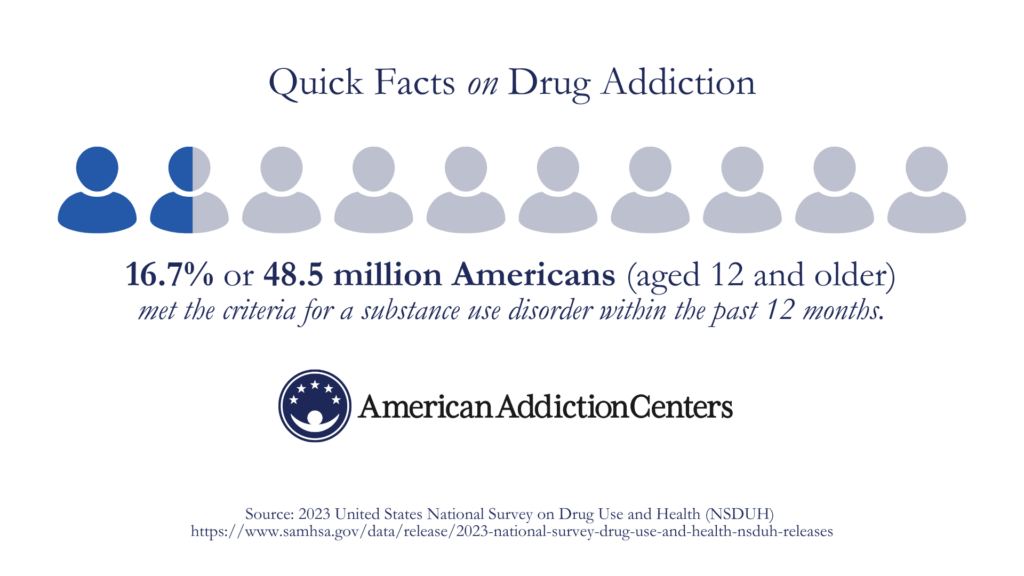
In the US, 16.8% of Americans aged 12 and older struggled with substance use disorder.
It gets even worse when you factor in other addictions such as pornography, gambling, gaming, etc.
I mean, these are terrifying statistics. Billions of people worldwide are suffering from all sorts of addiction, and there doesn't seem to be an effective way to fight it other than strong willpower, a supportive team, and a rehabilitation programme.
However, there have been early works on neuromodulation that could show some promising signs for fighting addictions.
Neuromodulation works by sending electrical pulses to certain areas of your brain to reduce cravings. The goal of the electrical pulses is to target the reward pathways in your brain.
Early studies show promising signs for reducing substance use, but it is still in early trials, and more work needs to be done in the area to determine the long-term negative effects of it.
Furthermore, if they were to pass clinical trials and move into the health market, it would likely be very expensive.
So there are two issues:
- Firstly, how do we make more progress in neuromodulation? We are definitely going to need some very smart neuroscientists working in this area, but of course, understanding how the brain works in more detail is also important to cover.
- Secondly, we need to make treatment more affordable. If multiple medical companies were to compete against each other, this would drive prices down. Furthermore, reducing the complexity of the treatment would also lower the cost.
To be clear, I don't think we should just force people to use this if they are addicted to something. I believe to a certain extent that removes your human right of choice, but it should be available so that people who want to get rid of their addiction can do so.
Technology companies, the adult industry, and the substance industry all try to exploit our reward circuitry in our brains to force addiction or symptoms very similar to addiction.
If we could change that so that we wouldn't be at the mercy of these companies, this could be an incredibly beneficial breakthrough for humanity. Not only would we all be more productive, but we would also be happier.
Of course, we should also think about the ethics and morals behind this technology. Is there a slight chance that it could mean we lose the ability to be passionate about things, instead, we have these good and bad feelings, but nothing deeper than that? That sounds scary, and most people would probably not choose it if that were the case.
Rising Wealth Inequality
The middle class is shrinking. If the middle class ceased to exist, we would be living through another Victorian era.
Wealth inequality is becoming an increasingly problematic issue in the world we live in. If you don't know what wealth inequality is, it is simply the unequal distribution of assets across people.

You can think of it like this. Higher-income individuals own a lot of the assets in the world. The middle-income individuals own a small but still decent amount of assets in the world, and low-income families own a small fraction of the assets in the world.
As we go through more and more economic fallouts, wealth inequality gets worse. For example, during the COVID-19 pandemic in 2020, people were given government funds. Some of that money ended up being gambled in the investment market and resulted in lower/middle-income individuals losing that money, and higher-income earners gaining it instead. Furthermore, when funding was needed to keep companies afloat during the economic standstill, it was the owners of the company who benefited the most from it.
The middle class is slowly shrinking, and this is a problem regardless of your economic ideology.

To be clear, I think capitalism isn't perfect, but it is a much better solution than most alternatives. It allows for people to be greedy (communism doesn't, and then when people are greedy, typically the elites, it leads to regime-change), and allows for efficient distribution of resources where they are limited.
In a world where abundance has not been achieved, socialist capitalism seems like the best way to go, and has been working for a very long time now. This will most definitely change if we manage to create a society of abundance (maybe through AGI and Robotics), but that is a chat for a much later day.
If you are like me in your thinking, you should definitely be concerned about a shrinking middle class.
Why is that?
Well, it's because most consumers are middle-class; therefore, if that dries up, so does your revenue.
Therefore, if the middle class cannot spend, you cannot make money, which means you must fire people, and that will lead to an economic spiral downwards.
If you want to imagine a time where there existed no middle class, I would recommend you read Charles Dickens and any of his books. That should give you a good idea of how terrible a lower and upper-class society is.
So what do we do?
Well, we need to tackle the issue of wealth being aggregated and kept at the top of society.
Now, increasing income tax is probably the worst way of doing this. We don't want to tax workers, because, well, they work... They aren't the problem; they use their time and generate money. Furthermore, if you think increasing income tax will target billionaires, you would be severely mistaken, as most of their wealth comes from dividends, which is a different form of tax.
Well, you could say, let's tax their assets. This again doesn't work. Taxing an asset on unrealised gains is not possible. If you had to pay a 25% tax on an unrealised gain of £100, then all of a sudden you lost all that money, not only would you be out £100 in profit, but now you would be down an extra £25 because of tax.
Furthermore, the ultra-wealthy are very cheeky. Instead of selling their assets, they put them up as collateral and instead receive a loan. This loan is tax-free, and they can spend it and pay it back with much more tax-efficient payments.
If you're interested in this topic, Gary Stevenson is probably a guy to have on your watch list. I think he provides a lot of context regarding the wealth inequality problem; however, he does sometimes bang on about the issue, without providing a detailed plan on how to fix it.
Personally, I think preventing the loaning of money in return for collateral of unrealised assets should be blocked. This seems like a massive loophole, one that should be promptly covered up. However, I'm unsure of what other things we could do to fix this issue.
The middle class is crucial to innovation and economic growth. When it doesn't exist, every part of the economy is hit. The upper class don't get revenue, and the lower class don't get hired.
Unfortunately, there is no way of getting rid of a class-based society when abundance does not exist. Even at that, the class-based society would transition from economic to societal. Therefore, for the benefit of everyone living within an economy, the middle class should be preserved.
Quotes Of The Week
- “A well-educated mind will always have more questions than answers.” –Helen Keller
- “The best way to predict your future is to create it.” – Abraham Lincoln
- “Strive not to be a success, but rather to be of value.” – Albert Einstein
- “We are products of our past, but we don’t have to be prisoners of it.” – Rick Warren