7 Days 7 Lessons #9

- Lesson 1: Don't Stop Trying: Roller Coaster vs. Freefall (Mindset)
- Lesson 2: Investing vs. Trading (Finance)
- Lesson 3: AI & Robotics: One possible outcome with both (Technology)
- Lesson 4: What would happen if we lived in a Utopia? (Thought Provoking)
- Lesson 5: Do You Take Loyalty For Granted? (Relationships)
- Lesson 6: The Lie Of Being Average (Mindset)
- Lesson 7: Lifestyle Creep (Finance)
Hope you're having a great week! Let's dive straight into 7D7L #9!
Don't Stop Trying: Roller Coaster vs. Freefall
The mindset you must adopt to succeed.
I've just finished hanging out with one of my closest friends, and it's always a pleasure chatting with him. We speak about such a variety of things, and it's truly refreshing. During a segment of the conversation, I was congratulating him on the massive U-turn he's made in his life.
He asked me if being disciplined ever gets easier, and I said it does, but it's still incredibly hard for me. Some months are great, and some months suck. Like recently, I've been trying to 100% a game, and it's consumed around 30 hours of my life. Just thinking about it brings tears to my eyes. But sometimes I'm locked in, and I barely touch video games, and I just feel like I'm on top of the world.
I told him that the most important thing was to keep trying. We've all heard the quote "you only fail when you've stopped trying", and although it's cliché, it's true.
If I stopped trying to be disciplined every time I failed, I wouldn't be on a roller coaster (where I'm going up and down in life). I would be free-falling with no brakes.
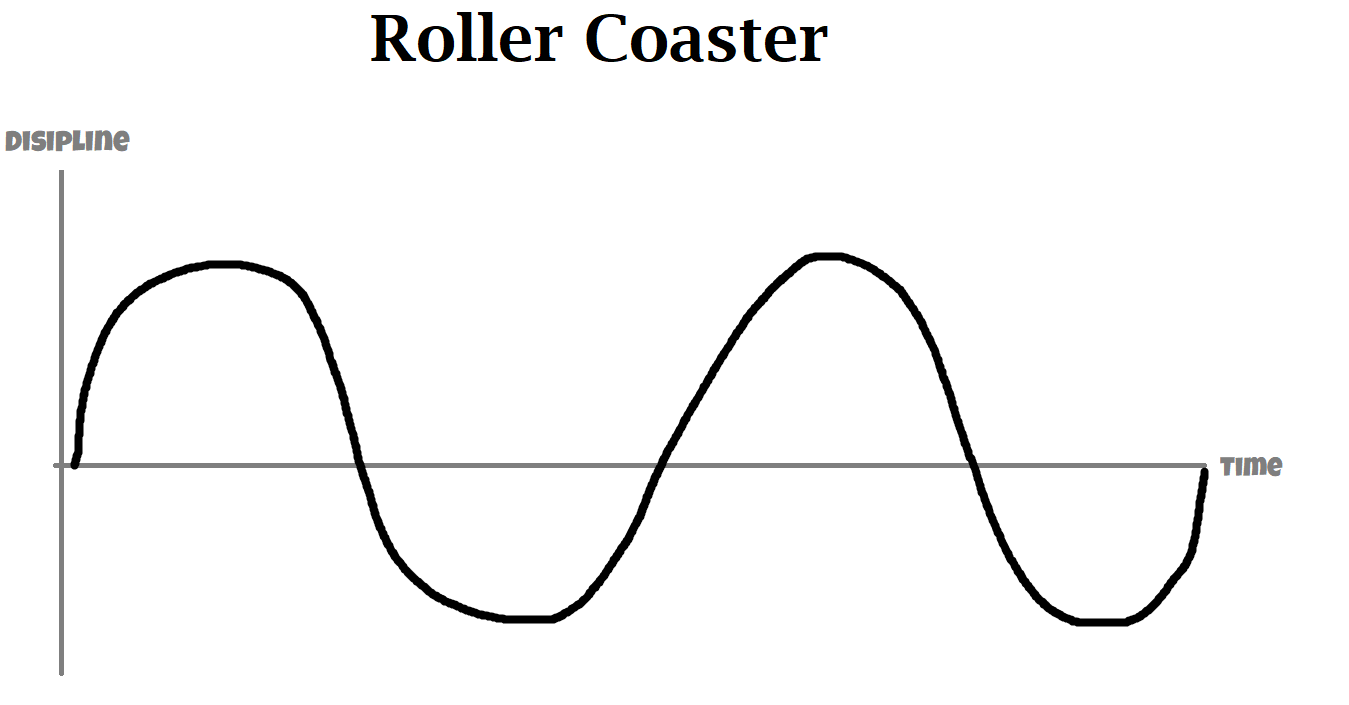
Although the downturns suck, I would rather be on a roller coaster than free-falling, because I know eventually, as long as I keep trying, I'm going to ride to the peak.
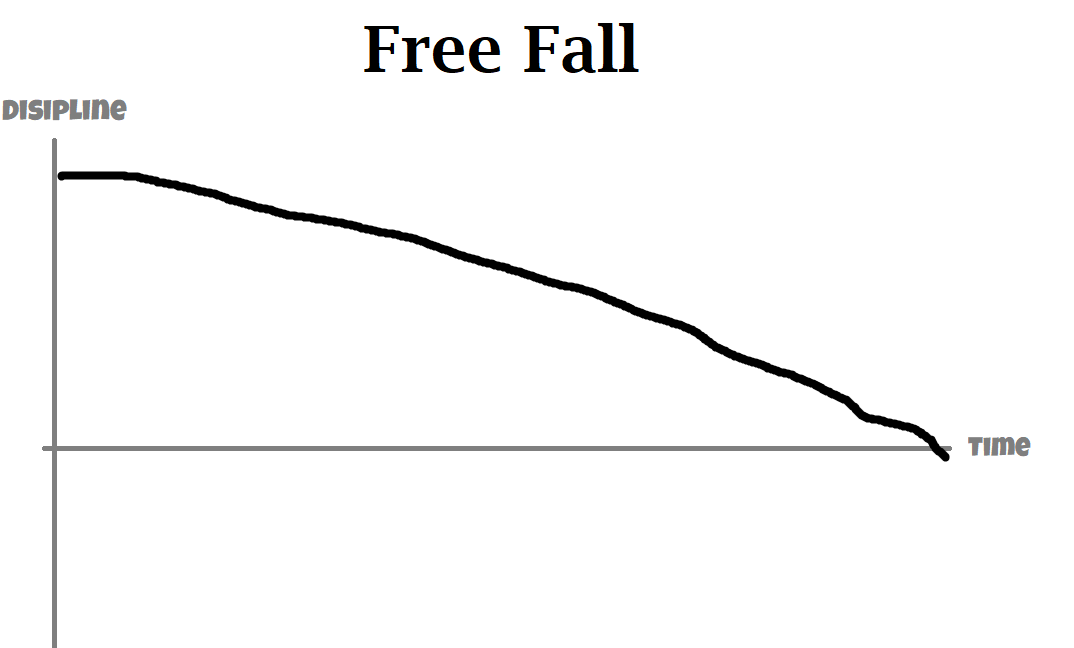
I mean, how can we enjoy the good times without the bad times? How can we progress if we're scared of failing? How can we achieve success if we stop trying?
Sometimes it's just easier to say I give up. I can't do this anymore. I don't want to do this anymore. I've been there, I've chosen both options, and have always been disappointed by the outcome of giving up. It's never made me happy. It's only led to regret and never to anything good.
Life is not meant to be easy. Good things come from being disciplined and being uncomfortable. It might suck, but the long-term rewards are incredible.
TLDR: Don't give up; if you do, you're getting off the roller coaster of good and bad, and you're entering a slow free fall to unhappiness.
Investing vs. Trading
Learning the difference is crucial for having long-term success.
Speaking to someone about investing can sometimes be a bit of a minefield to navigate. Some responses I've heard are:
- "So you're just gambling?"
- "You must have lost a lot of money recently!"
- "You can't win in investing, you're playing against multiple billion-dollar companies who have the best tools and people in the world for this sort of stuff."
Unfortunately, investing and trading are sometimes grouped into the same bucket.
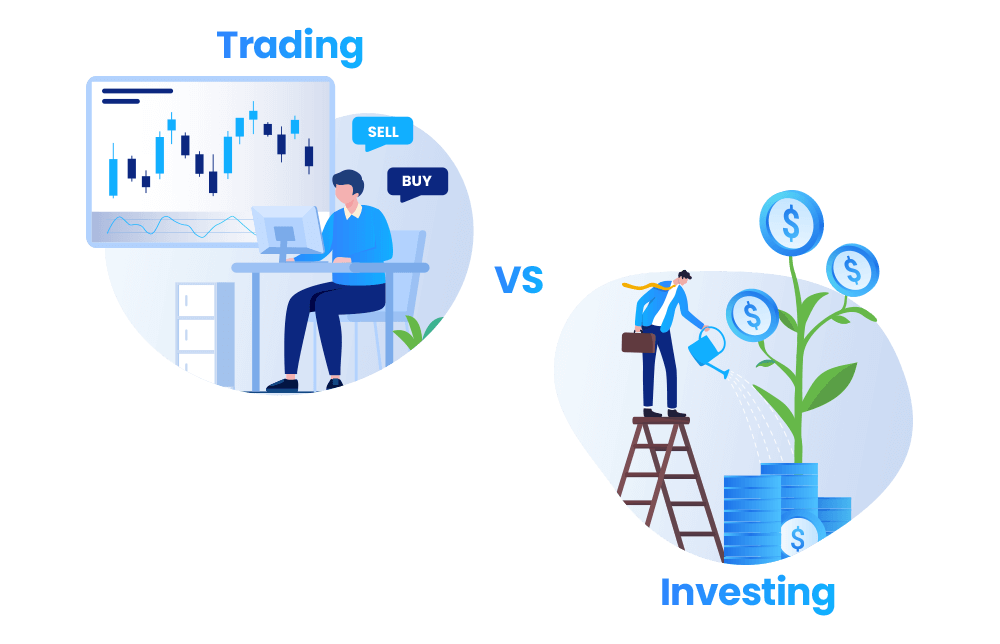
To most people, trading is gambling. Buying and selling every day on out-of-date information, against people with billions of dollars of backing who have unlimited resources, is a sure way to lose all your money. It is simply improbable that you can win. The statistics support this: around 95% of day traders lose money.
However, investing is different. You're choosing relatively low-risk assets that you believe will go up over 10+ years. You're playing the long game. Unlike day traders, you can deal with the stock market crashing 40-50%, whereas they can't, because eventually, you believe that the market will rise, whereas they need it to rise now.
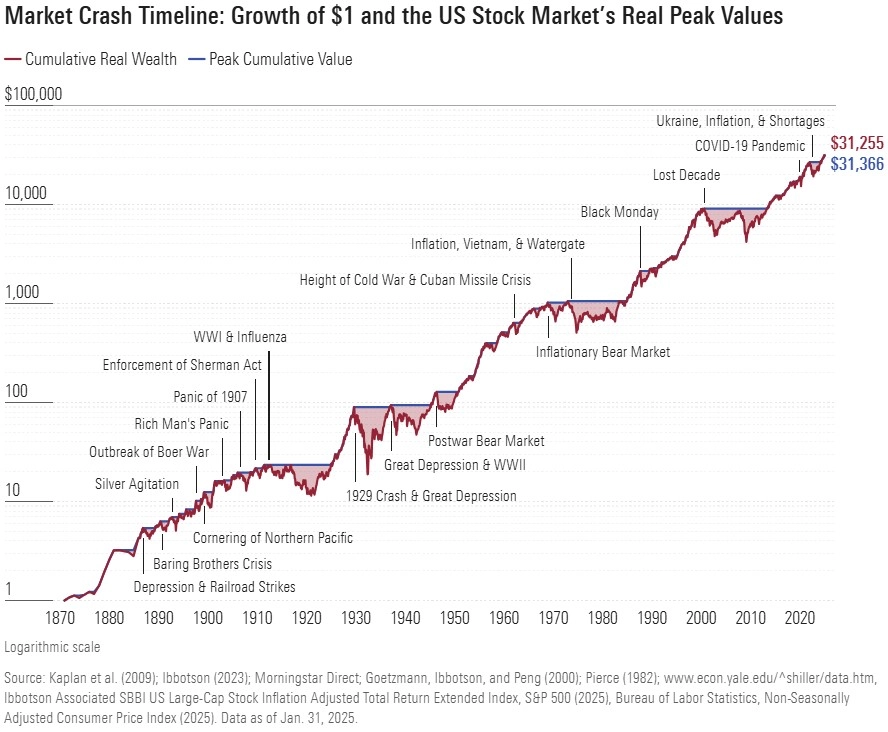
Investing isn't your primary source of revenue; it's a compounding tool for your retirement and other long-term purchases. That's why you can afford for it to be in the negative for a long time, whereas day traders need it to match their expectations.
Think about it like this. Your pension, state pension or private pension is already putting your money into investments like the S&P 500. These massive organisations aren't playing against anyone to win their money; they simply hold the most successful companies that are likely to increase in the long run because of the increased value they will produce. Day traders, however, are playing against people to make their money. So, unlike day trading, where there has to be a loser for there to be a winner, investing doesn't need the same condition; everyone can win.
Pensions are typically invested in stocks, bonds, property markets, etc. The same things you can choose to invest in now. Day traders aren't buying these safe assets; there simply isn't enough money in them for them. Instead, they play with hyped and small-cap/penny stocks.
Even the money stored in your bank is invested. They take 90% of your cash deposit and use it to make more money. This is called fractional-reserve banking.
Sometimes this is by loaning the money out, but sometimes it's by investing it into long-term assets.
When I found this out, I became passionate about cutting the middleman out of the game. I don't want to put my money into a savings account making 2%, when the bank is making 8% and keeping 6% of the profits. I want it all, and it doesn't take much effort to learn how to do it.
The likelihood of you winning in the day trading scene is worse than a roulette table. However, to win in the investing scene doesn't require much skill. You can pay a broker to do it for you, or you can take some time to learn the best stocks to invest in.
When people get investing and trading confused, it is because they simply don't know, or can't understand, how buying a very small percentage of a company allows them to make money.
Take some time to learn what investing is and how to do it. Ignorance is what keeps people in shackles.
TLDR: Trading is worse than gambling; it's incredibly unlikely to be successful at. Investing is how pensions make their money to fund your retirement.
AI & Robotics: One possible outcome with both
Could AI and Robotics kill employment completely?
AI is the next big thing; there is no doubting that. However, not many people are talking about the downstream effects of it years down the line. Today, I wanted to talk about one of them.
I want to first introduce two basic things about how the economy works.
In every economy around the world, we have consumers and producers. Producers make the goods and services - these are your typical companies like McDonald’s, JP Morgan, Microsoft, etc.
Then you have consumers, who buy these goods and services.
AI, as we understand it, is threatening to take away most, if not all, white-collar jobs (knowledge-based/corporate jobs).
About 50% of the current workforce in the US and the UK are white-collar jobs (A bit hard to find an accurate number). Microsoft AI Chief Executive predicts that in 12-18 months, AI can replace most white-collar jobs. I doubt this, but let’s fast-forward 10-15 years and see if this could be a reality.
What does that mean for the economy?
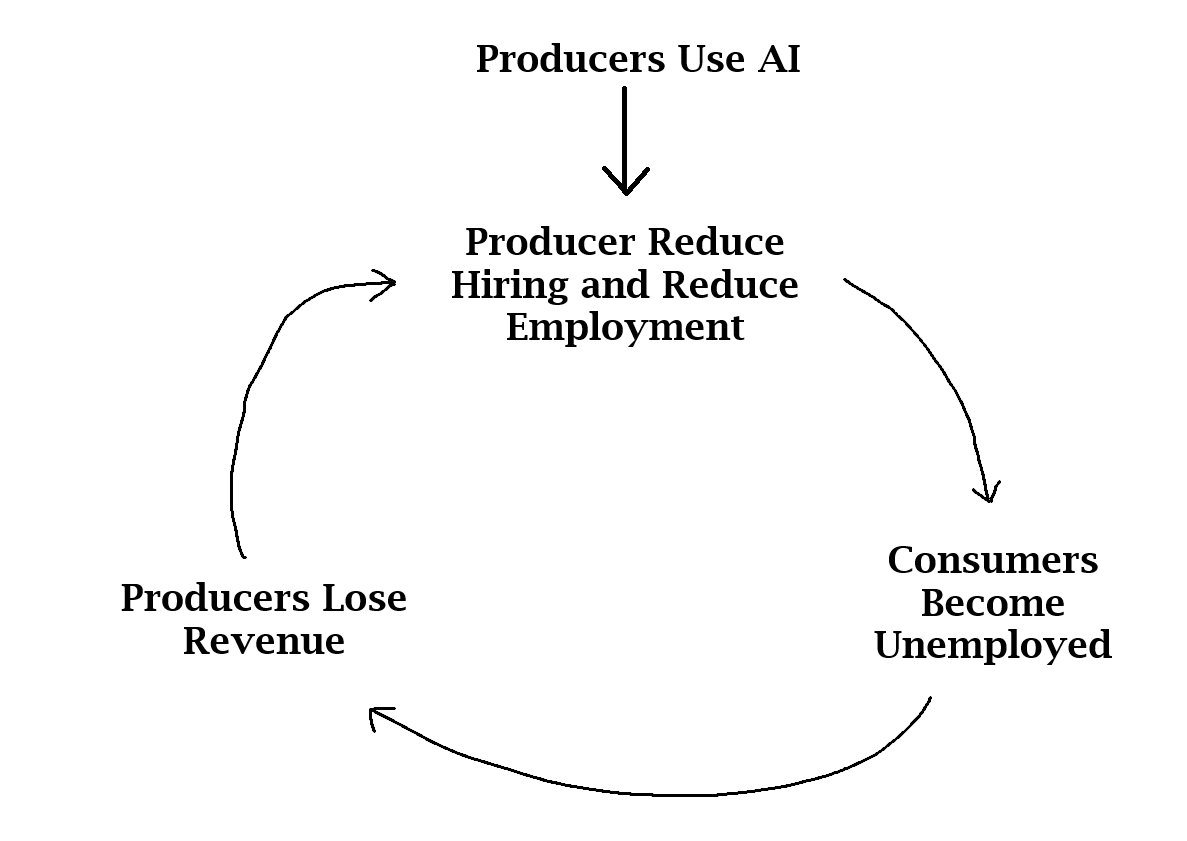
Companies start using AI to replace jobs, people then become unemployed, because of the lack of salary they have, they stop consuming as much, and eventually producers receive lower revenue.
This loop would then continue to happen until an equilibrium is met (where jobs can no longer be replaced). Fast forward into the future, when Robotics gets so good that even blue-collar work starts being replaced, what happens then?
Henry Ford had a great quote linking back to this effect
“If machines replace workers, who will earn the wages needed to buy the products those machines make?”
– Henry Ford
He was talking about car manufacturing here, and in this moment, he was wrong. But maybe he wasn’t, maybe he was just early. I think this quote might be right for the AI revolution.
People claim that after every big innovation, new types of jobs get created. This could very much be the case, as it was for different revolutions in the past. But I’m uncertain about that. AI would replace our brains, and Robotics would replace our physique.
I then ask what more can humans provide? I’m not sure, honestly, but maybe you know something I don’t.
Let’s assume for a second that AI does end up replacing most jobs.
How do we share resources producers make, like food and water, fairly if the majority of workers aren’t earning money to buy said goods? Honestly, the only possible outcome surely has to be UBI? Or we could go back to bartering?
Let me give you something to chew on. Sam Altman, the man who started the AI revolution (and may be on track to kill it...), has two businesses. One of them, his most popular, is OpenAI. However, his second WorldCoin is a cryptocurrency that governments could use to facilitate UBI.
I don’t know if what I’ve written will pan out; maybe it will, maybe it won’t. But I just wanted to bring this to your mind so you could ponder on it too. After all, two minds are better than one when trying to come up with a solution.
Could AI & Robotics lead to a Utopian World? Possibly. What does a Utopian World end-up looking like for us? Check out the next lesson to find out!
TLDR: Many AI optimists and revolutionaries believe that AI could kill employment. They might not claim it with their mouths, but they definitely believe in it, and where they spend there money and time shows it.
What would happen if we lived in a Utopia?
Is a Utopia even a good idea?
Following on from the previous lesson, I wanted to talk about what the distant future, where AI is doing everything for us, could look like.
I don't think it's unrealistic to talk about this nowadays, especially where many AI optimists are promising a future where AI will bring a utopian-like world.
Where I stand, I'm not 100% sure; however, there are two possibilities that I can think of when it comes to a utopian civilisation.
First, the WALL-E utopia. If you haven't watched this movie, you're missing out, but if you have, you probably know where I'm going with this.
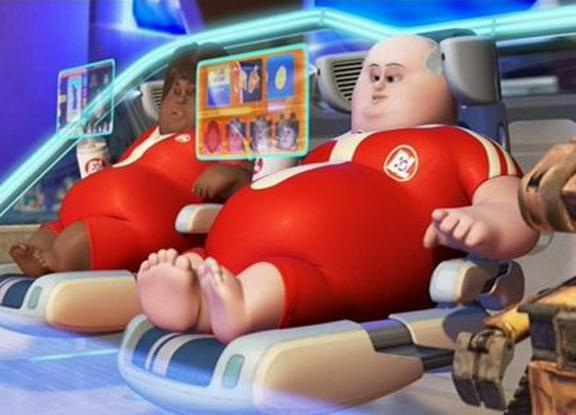
With everything available to us, and there being no need to work, we could quite quickly turn into an unmotivated society that simply wants to consume things that bring us happiness, dopamine, and whatever other stimulants that could help us enjoy life.
A small number of people would be needed to supervise AI, govern countries, etc. But that would be a fraction of employment compared to what we have today. It would also probably be driven by those who are passionate about the job, not the money that it brings, because there probably wouldn't be any money. In a Utopia, we would either have an unlimited amount of goods or a Universal Basic Income (UBI) to fairly distribute the goods.
We would be born to grow up and consume. That's it. I don't know about you, but that sounds like quite a miserable life. Humans gain a sense of purpose from survival and the possibility of more. From the need and the want to do things. If we no longer needed or wanted to do anything, would there be much of a point to life?
This moves me swiftly to the other side of the coin. Universe 25. Universe 25 was an experiment carried out on mice. Essentially, in this experiment, the mice were given everything. The best conditions to live, with all the food and water they needed. The scientists made everything comfortable. So much so that eventually they started killing each other and killing themselves off.
The lack of needs in life seemed to have led them to their own demise. Comfortability quite literally killed an entire generation of mice. To be clear, that wasn't the only reason why the society collapsed. Other things, such as overpopulation and lack of social roles, had a part to play, but it is still something we should consider.
In both of the examples I provided above, living in a Utopia doesn't sound amazing. Even though having all you want and need theoretically sounds good, what does that do to our drive to live?
Like most of my writings on the future, I'm not sure it will pan out the way I described, but I don't think we talk about this nearly enough, so I wanted to share some thoughts on this increasingly important topic.
TLDR: Utopia, by definition, sounds like the perfect place to live. But a life with no meaning, best-case scenario, sounds boring and worst-case scenario could kill us off.
Do You Take Loyalty For Granted?
Being comfortable - the silent relationship killer.
Our significant other, our family, our friends, our colleagues, every single one of these relationships are so beneficial for us. Relationships are what make living a life worthwhile.
Can you imagine yourself without the people you love most in your life? Most of us either can't or don't even want to think about it. I don't blame them. I don't know what I would do without them.
However, sometimes our actions don't reciprocate our love for them. Especially the ones where you know they will have your back no matter what.
Have you ever been impatient with a loved one, even though you give everyone else your time? Have you ever come back home and take out your anger on someone else because of what happened at work? Have you ever said something you immediately regretted saying?
I have, and I think we all have too. We do this, not because we don't like these people, quite the opposite, in fact, it's because we love them, and we take their loyalty for granted.
Today, I just wanted to bring to your attention that sometimes we do this, but it's always important to tell them you're sorry and that you value your relationship with them. But let your actions do more than your words. Do as you say you will too.
After all, if you can't imagine a life without them, don't give them a reason to leave your life. Value them before it's too late.
If you're anything like me, you didn't realise why your actions were so different to the ones you love than from the ones you tolerate. Well, the answer is that you're taking loyalty for granted.
Next time you feel like treating your loved one wrongly, think twice, and imagine a life without them. Would it be better? Probably not, so give them the love and respect they deserve.
TLDR: Complacency is the silent killer of relationships. It turns someone's loyalty against them, and it causes you to lash out at your loved ones for no reason. Recognise it and stop doing it.
The Lie Of Being Average
None of your ambitions are possible by being average.
I don't know about you, but I've been told so many times "to just be like everyone else". Or heard other people say they "want to be like everyone else". Let me shatter this myth. The average person is not doing well in life, and that's a fact.
On the weekend, go for a walk around some of the busiest streets in your city. A large chunk of them are just drinking because that's what's expected of them, spending money on shots to make themselves look good, and then coming back home, having poor sleep, and waking up the next day with regret.
I don't doubt that a small minority of people like going to the pub, drinking, and hanging out with friends. But the sheer volume of people on the streets doing this isn't represented by these small minorities.
Below, I've listed some ambitions a few of my friends have. Let's see what the average person is doing relating to these ambitions.
- I want to have a stress-free life - "74% of people have felt so stressed they have been overwhelmed or unable to cope."
- I want to be happy - "51% of adults who felt stressed reported feeling depressed, and 61% reported feeling anxious."
- I want to be financially independent - Nearly half of the UK doesn't have enough savings to deal with a major life crisis.
- I want to be on a good salary - The Average Salary in the UK is around £35,000 - £45,000.
I can keep going, but it would require me to go into more niche wants, like career ambitions, cars, homes, etc.
All of this is to say that being average does not fulfil the ambitions and dreams you have for yourself.

To be clear, being average is not a bad thing; I just want you to be honest with yourself. Are you setting yourself realistic goals, or are your expectations and reality completely mismatched?
I see so many people claim one thing with their mouth, and act completely differently. That's a trap that I've fallen for too much in my life. If you don't even keep your promises to yourself, why should anyone expect you to keep their promises?
Break the lie that you can achieve what you want in life by being average. Aim for the tail end, go all in on your goal; failing or succeeding are better outcomes than just being like everyone else.
If you're reading this, you probably don't care about what other people think. You're probably motivated to be better. You probably don't want to be average.
Don't let the lie of being average destroy your ambitions. This lie is as dangerous as the lie doctors used to sell when they were recommending cigarettes for lung health.
TLDR: Being average may make some people happy, but if your goals are ambitious, then being average will not get you to realise those goals. Strive for better. Take the risk and stand out.
Lifestyle Creep
I think one of the biggest financial mistakes comes from comparing what you have to what others have. Social Media has not helped this. With more than half of the world having access to what everyone else in the world is doing, no wonder people, now more than ever, are spending ridiculous amounts of money trying to keep up with the new trend.
"Keeping up with the Joneses" in 1913 was the urge to match neighbours or peers in material goods, wealth and social status to avoid looking inferior. The name has changed to be similar, but I don't find it ironic that one of the most popular shows in the 2000's was "Keeping up with the Kardashians".
After all, who doesn't want to look at the stupid things people own or do with their almost infinite amounts of money?
What's key to highlight here, however, is that this has existed long before the internet, although it has been exacerbated by it.
Let me be clear. What makes you happy is different to what makes others happy. You aren't a robot made in the same way as everyone else; you're a unique human being who has unique tastes and desires. I've made a blog post about this before if you're interested.
For example, I love playing games, learning, and technology. However, my fiancée loves reading books, candles and medicine. It would be silly for me to try to "keep up with her" by spending money on the things she likes, because it would be a waste of money.
Just like it should be silly for you to spend money on what others like, just to try and get some sense of happiness and purpose from others around you.
Lifestyle creep, the increased spending that occurs with the more money you earn, is one of, if not the biggest, factor as to why people aren't financially well-off. Psychology of Money, the Atomic Habits of Finance, talks on this topic incredibly well.
Stop comparing yourself to others. Stop comparing what you have to what someone else has. Just stop for a second, and ask yourself, "Do I actually want this, or am I buying this for social approval and some clout"?
And to be clear, no one actually cares about what you own. If you're in a Lamborghini, they don't think "wow that guy is cool because he's in a cool car", they think "wow, I would love to be in that car". As Morgan Housel put it:
"No one is impressed with your possessions as much as you are".
– Morgan Housel
To be clear, I did this so often. I bought expensive suits from Hugo Boss, Armani belts, and expensive Nike Jordans just to look good and get some sort of social approval.
All that did for me was teach me a valuable lesson and cost me thousands of pounds in the process. Take this lesson for free and thank me later.
TLDR: "Spending money to show people how much money you have is the fastest way to have less money".
– Morgan Housel
Quotes Of The Week
- "Education is the key that unlocks the golden door to freedom." —George Washington Carver
- “If machines replace workers, who will earn the wages needed to buy the products those machines make?” – Henry Ford
- "No one is impressed with your possessions as much as you are". – Morgan Housel
- "Spending money to show people how much money you have is the fastest way to have less money". – Morgan Housel
- "There are more things likely to frighten us than there are to crush us; we suffer more often in imagination than in reality ." – Seneca