The 7 Pillars of Life

Every time I sit down and want to set goals, it seems like I'm always attracted to 7 categories (Faith, Health, Relationships, Love, Career, Personal Development, Finances). Recently I realised that these are quite universal (with a few modifications) and can help anyone when setting goals they want to achieve. Thus is born the 7 Pillars of life.
I truly believe setting goals in life is one of the most important things we can do as it helps us reach our true potential.
Another thing I noticed was that some people might attach different weightings to each pillar.
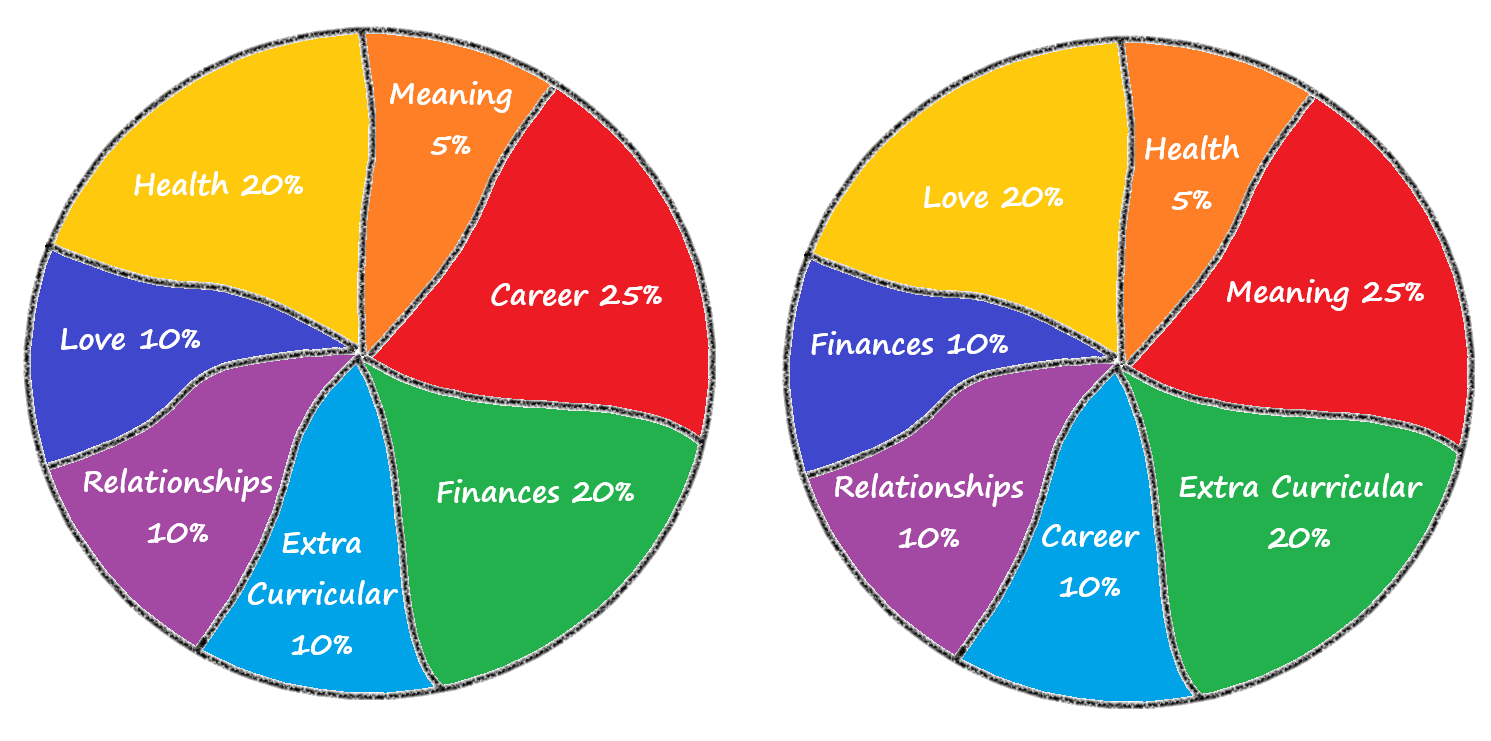
Furthermore, you can assign a score to each pillar (0-10), and the closer all your pillars add up to 70 (when summing up all the pillars: pillar weighting x pillar score)) the happier you are.
So not only is this framework excellent for helping you set out goals in your life, but it also helps you identify the areas of your life you need to focus on more to be happy.
One final point - I believe that no pillar can be 0. This is because all of these categories are necessary for us to enjoy life to it's fullest. Living without one of these pillars is a recipe for disaster and if you disagree with me, I would urge you to spend some time seriously thinking about it.
Meaning
This category is probably the most important of all. Although some may rank this as the lowest in terms of practicality - I would really disagree. Finding the meaning to life (or at least trying to find it) is essential for developing your moral compass and deciding what you should do next. For me, the meaning of life is Christianity, and it guides my moral compass, my attitude to others, and my attitude to the circumstances I'm in.
Some example goals you could set include:
- Reading into religious scripture such as the Bible or the Torah.
- Reading philosophical pieces such as Meditations by Marcus Aurelius
- Watching debates between two beliefs
I am certain that someone who has invested their time into finding meaning will result in them having a meaningful life. I've seen the profound impact it has on my life, and would urge everyone to try it too.
Health
A brilliant quote sums the importance of this pillar.
Those who think they have no time for bodily exercise will sooner or later have to find time for illness.
Edward Stanley
I know at times it seems like we are young and healthy and that nothing will happen to us. I mean sometimes we even feel immortal. However, I would urge you to lose this complacent mindset, because one day you might end up in a situation where you've lost half your life span and you can't do anything to get it back.
It doesn't even have to be much. There's been plenty of studies showing that doing very small amounts of exercise have good results on lowering the chances of chronic illness and increasing your life expectancy. Furthermore, with regards to eating, you don't have to have an incredibly strict diet. One that meets your calorie intake recommendation and a couple of cheat days per month is a great way to enjoy food in a healthy way.
Some example goals you could set include:
- Doing X amount of home workouts a week.
- Eat X amount of meals and Y amount of snacks per day.
- Walk at least 7,000 steps per day
If you're not healthy, you won't be able to enjoy life to it's fullest. You are essentially on an unsustainable journey of enjoying life, but one day, that gas will run low, and you won't be able to enjoy it as much. You would have started a marathon in a sprint and exhausted yourself to the point where you'll need to walk to the finish line.
Relationships
Humans are social creatures. Living a life of solitude is not healthy, and COVID is a case study of that theory. Plenty of studies show that not enough social interaction impacts your mental health dramatically.
You need to find the right people. Simon Sinek defines what he considers friends:
- Someone who inspires you
- Someone that makes you laugh
- Someone that pushes you
You need friends like this. You need people who would stick with you no matter what is going on in your life.
Some example goals you could set include:
- Having coffee with person X (someone I want to get to know more).
- Seeing close friend Y.
- Phoning my mother.
Life is not meant to be lived alone, invest in your relationships as early as possible, because it gets much harder when you're older.
Love
Finding the love of my life at the age of 15 is definitely the thing I'm most proud of. It has saved me from the headaches of dating, situationships, and mindless chatting to people with hopes of securing a future wife. She's the most incredible person in the world, and a large reason why I'm always trying to improve myself daily, because I want to provide a better life for her and our future family.
But even with this, I must continue to water and feed this plant, because if I don't put the time and effort into doing this, this love life I have could crash and all be lost. It requires due diligence and commitment, so don't take it for granted!
Some example goals you could set include:
- Weekly date nights
- Asking person X on a date
- Buying a present for your significant other
Love is motivating, it's your best friend, it's your ride or die, it's your forever, it's your home, it's your comfort, it's nearly everything. I would highly encourage you to look for love, because without it, you are missing out on a large portion of happiness.
Career
No matter how you put it, you're going to have to work in your life (unless you're incredibly rich and just want to sit around at the beach all day). For that reason alone, you should find a place of work that makes you happy (or at least not unhappy), that provides you enough money to live and enjoy life, and allows you to reach the goals in the other categories. Some people might hyper prioritise their career and others may just see it as a means to an end, both are fine as long as you acknowledge it.
Some example goals you could set include:
- Reaching a salary of X
- Working in Y company as Z job role
- Keeping busy at work with a massive project every month
One thing I would urge you to put into perspective is whether a career making a lot of money is actually what you want. Or is a career that's more cyclical, that allows you to have enough money for your spare time, but also enough free time to enjoy the money you get, better for you.
Schools till this day push you to university so you can earn as much money as possible, but money is not always the answer to what makes you happy, yet the world has made it seem that way. Putting life into context is incredibly important when deciding how much money you need to be happy.
Extra Curricular
Extra curricular is anything you do in your free time (at least outside of the above categories). This typically includes hobbies and side hustles. Every weekday you have 8 hours completely to yourself, this is where you fill it up with the things you love doing.
Knowing this, I would urge you to do two things. Firstly, have a variety of hobbies. One hobby can lead to addiction which probably isn't healthy. 2 or 3 is a much better number.
Secondly, make it intentional, it might sound silly, but set yourself goals for video games, series, movies, etc. After all, you do this for the things you don't love doing, so why not do it for the things you love. It shows commitment and care.
Some example goals you could set include:
- Watching series X this month
- Completely game Y this month
- Reading 3 books this month
Don't just plan your busy time, plan your fun time too!
Finances
No matter how you put it, you'll always need money to live, and because of this, your finances will help you survive in this world.
You should set some goals to learn the basics of personal finance, what investing is, the basics of economics, how to manage a budget, how to manage debt.
Although you might not be interested in finance, finance is interested in you, and so if you play ignorant to it, it will happily take advantage of you for it's benefit.
Final Points
I hope you enjoyed reading this as much as I did writing it. The 7 Pillars of life is a framework I've been living by for a while now, and it's dramatically changed my life, and I hope that by sharing it with others it can do the same for you.
Two exercises before you go:
- Create a pie chart of these 7 categories, and put a weighting to each one. Then assign a score to each one. Find what's going well, and what needs improvement.
- Set yourself at least one goal for each category and see how it goes for you!
Remember, with any goal, it isn't sustainable if you don't enjoy the journey to it, so be realistic, and make it enjoyable for yourself.
Setting goals is the first step in turning the invisible into the visible
Tony Robbins