7 Days 7 Lessons #18

- Lesson 1: First-Principles Thinking (Problem Solving)
- Lesson 2: Loss Aversion (Psychology)
- Lesson 3: Dollar-Cost Averaging (DCA) (Finance)
- Lesson 4: Chesterton's Fence (Decision Making)
- Lesson 5: The Stockdale Paradox (Mindset)
- Lesson 6: The Prisoner's Dilemma (Relationships)
- Lesson 7: Identity-Based Habits (Habits)
First-Principles Thinking
Innovative solutions come from new ideas based on truth, not other people's ideas based on assumptions.
In life, a lot of the things we believe are often assumed to be correct, especially if we've heard or seen them from others. This is called reasoning by analogy. This is perfectly normal to do. If we didn't, we would be in a perpetual loop of continuously asking questions. It would be impossible to live a normal life.
However, when it comes to solving a problem, it is important to keep asking questions and not assume things to be true. This is called first-principles thinking, popularised by Elon Musk but first spoken about by Aristotle.
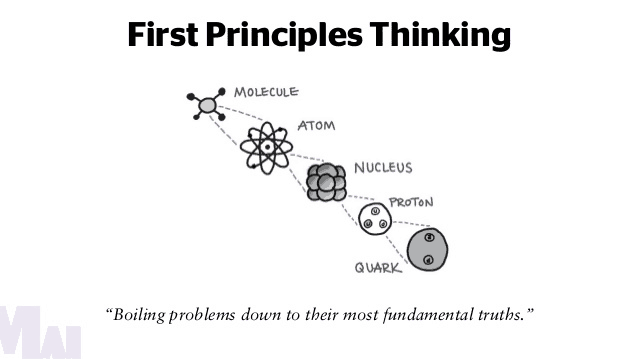
First-principles thinking is simply removing all the assumptions from a scenario and highlighting the foundational truths of the situation. From that, you can begin to build on these truths with more truths, until eventually you arrive at a solution based on facts rather than assumptions.
This way of thinking means not assuming something is true because that's just the way it is. I see this play out in my life quite often. For example, at work, I've often been encouraged not to take things at face value and to suggest things outside the norm because of the possibility of creating a new innovation or efficiency. Oftentimes, we get carried away with just taking things at face value and forget to ask why things are the way they are.
Forgetting to ask questions can hinder the amount of progress we make in various areas of our lives.
Elon Musk has two great examples of first-principles thinking:
- Regarding batteries for the Tesla cars. At first, people in the industry always assumed that making batteries would always be expensive. However, after applying first-principles thinking it was found not to be the case.
"What are the material constituents of the batteries? What is the stock market value of the material constituents? It's got cobalt, nickel, aluminum, carbon, some polymers for separation and a seal can. Break that down on a material basis and say, 'If we bought that on the London Metal Exchange what would each of those things cost?' It's like $80 per kilowatt hour. So clearly you just need to think of clever ways to take those materials and combine them into the shape of a battery cell and you can have batteries that are much, much cheaper than anyone realises."
Elon Musk and Kevin Rose Interview
- Regarding space travel and rockets. People often look at spaceships and imagine dollar signs next to them. However, spacecraft have gotten significantly cheaper thanks to SpaceX and their first-principles mindset, going from $85,000 per kg in 1981 to just a few thousand dollars in 2026.
"I tend to approach things from a physics framework. And physics teaches you to reason from first principles rather than by analogy. So I said, OK, let's look at the first principles. What is a rocket made of? Aerospace-grade aluminum alloys, plus some titanium, copper, and carbon fiber. And then I asked, what is the value of those materials on the commodity market? It turned out that the materials cost of a rocket was around 2 percent of the typical price — which is a crazy ratio for a large mechanical product."
Elon Musk and Chris Anderson Wired Article
The idea of first-principles thinking is to decide whether what you are doing is actually the right thing to do or whether it's something you've just adopted through your interactions in life.
There's a reason why we often make assumptions in life: it's because we don't have the time to ask every possible question and to validate its truth.
However, in areas of life where it's important to be the best of the best, such as your personal life, or at work, or on the side hustle you are working on, asking every question to see whether it is a truth or an assumption is critical to success.
TLDR: Breaking down a topic to the truths of the matter is where innovation and efficiency come from.
Loss Aversion
Sometimes the risky decision is not taking the risk.
I want you to imagine a scenario where you can either flip a coin or not flip it. If you flip, there are two possible outcomes: heads means you gain £1,000,000 straight into your bank account, but tails means you lose every penny you own. Would you flip the coin or would you choose not to?
Most people would say no. Even when you consider that you’d likely make far more money than you’d lose, the risk still feels compelling. The probability of success is 50/50, which aren't terrible odds, but as humans, we’re very risk-averse. We don’t want risks that threaten our comfort and our current situation.
If I told you the odds of getting the £1,000,000 were 75% instead of 50%, you’d probably still hesitate to flip the coin because it still feels risky.
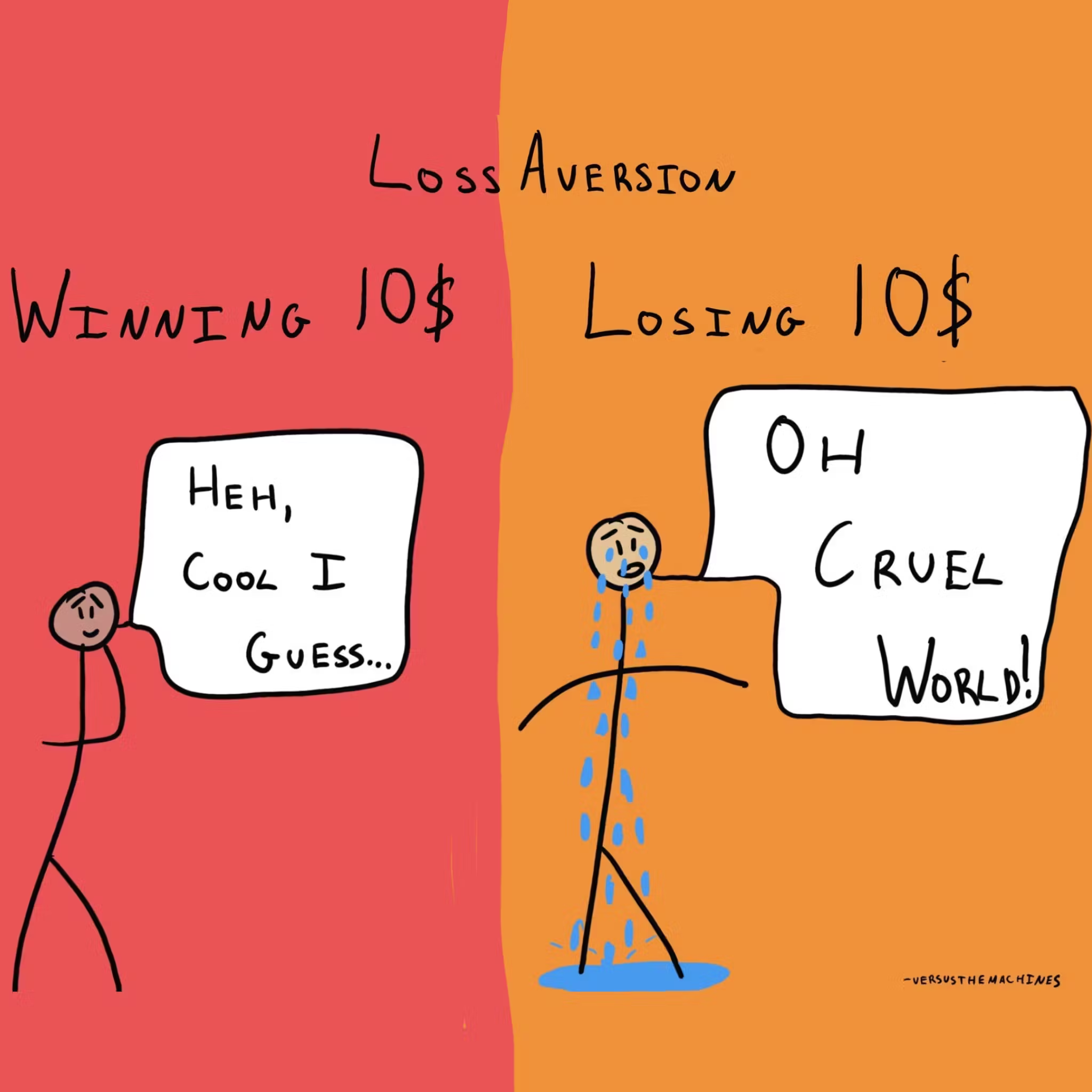
Loss aversion is the idea that we value negative consequences more highly than positive ones. So, in the example above, most people would say no to flipping the coin.
I've touched on this in a previous lesson: the endowment effect. Put simply, it’s the idea that we value something more once we own it.
For example, if I asked you to buy a £5 mug, you might hesitate and say you don’t need it. But if I gave you the mug to test, you’d be less willing to part with it for £5, and you might value it more, perhaps at £7. This is the endowment effect in action. Many businesses use this with money-back guarantees and free returns, because once you have the item, you’re less inclined to give it back.
I think it’s really important to recognise the natural tendency to be risk-averse. Sometimes it’s a good thing, but other times it holds us back. There are moments when we should push toward a risk, yet we end up not taking it because we’re naturally risk-averse.
The scenario above is a good example of this. It would statistically be more sensible to take the coin flip. However, rationale and loss aversion don’t always mix well.
Humans developed this natural risk aversion because we only have one shot at life. You can’t fight a lion and then, once you realise you’re going to die, reset.
Because of this one-shot-at-life mindset, you tend to avoid many risks. But sometimes you need to realise that if you take a risk, it isn’t going to end your life. In fact, in most scenarios, a risk does not end your life; it might set you back, but it is never as definitive as we once perceived it to be.
I don't intend to paint loss aversion as a negative. As I mentioned before, it's an evolutionary trait that was developed for a reason. But life isn't as definitive as it once was. It's actually relatively safe. Be bold and take the risk if it makes sense.
I'm not telling you to go gamble all your money on black. That's not the idea I'm trying to convey. But if the reward is much greater than the cost, and if it won't cause a massive disruption to your life, then why not take the risk!
TLDR: We naturally want to take the less risky option, and we are scared of losing what we have. However, most decisions you make in life won't take everything away from you, and if that's the case, why not take the risk?
Dollar-Cost Averaging (DCA)
Investing a regular amount of your income into a reputable ETF, such as the all-world or the S&P 500, is one of the best ways to improve your investment returns.
Back in the day, when I first started investing, I used to invest quite sporadically. I was constantly buying and selling shares in companies, always looking at live prices for stocks, and feeling very emotional when certain investments I had made were down 50%.
A few years ago, I wanted to leave that stress behind and just wanted to follow the best advice when it came to personal finance.
After watching some of the best finance YouTubers, such as Graham Stephan and Damien Talks Money, and reading some of the best finance books, such as The Psychology of Money and The Intelligent Investor, it was evident that Dollar-Cost Averaging made a very solid return without requiring much input.
Dollar-Cost Averaging is simply the process of putting in a certain amount of money every month into a stock or ETF regardless of its performance. Its nature, which is consistency, is what makes this methodology so great.
So the three parameters you must choose are:
- When will you invest?
- How much will you invest?
- What will you invest in?
The first two questions can be answered based on your life. For me, investing after a paycheck, a small proportion of my leftover income, is the answer.
The third question requires a bit more nuance, but the most common things to buy include the S&P 500 ETF, such as VUSA, and the All-World ETF, such as VWRL. These are regarded as the "safest" investments in the world of stocks.
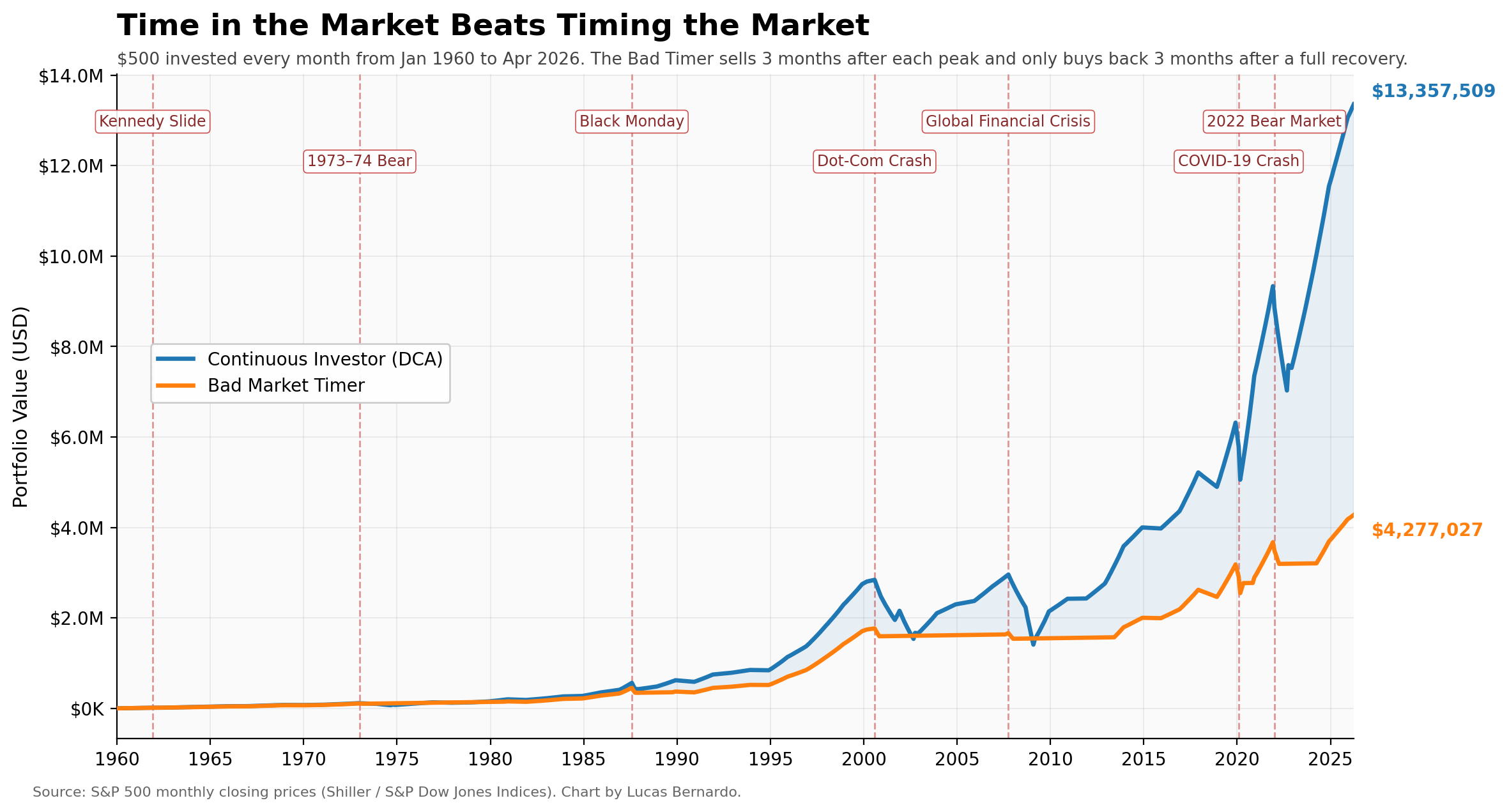
DCA works for two primary reasons:
- It removes the emotional side of investing. Emotions ruin your profits; that's not just a theory. That is proven by many studies.
- It allows you to buy a lot of shares when the price is low, and buy fewer shares when the price is high, meaning your average buy-in for the stock remains on the lower side.
I think it's easy to get carried away with investing in the stock market. We tend to overcomplicate it simply because the idea of making money from doing nothing is not natural. DCA steps into that uncomfortable feeling and delivers good returns whilst requiring very little effort from you.
Across many studies, DCA has proven to be one of the best investment strategies for the general population. One final thing I want to mention is that statistically, it is better to invest all your spare cash first and then to carry out DCA.
Before you do that, ask yourself whether the cash is important right now and whether you can afford to lock it up in a long-term investment. If you can, do it and keep DCA'ing afterwards.
TLDR: Dollar-Cost Averaging is a low-effort methodology that can make you serious returns in the stock market.
Chesterton's Fence
Not knowing the purpose of something is not a valid reason to discard it.
At work, it’s normal to inherit a code base from many different developers. Some people are still with the company, others left a long time ago. The code base is the backbone of a system, and inheriting it can be scary because you don’t know the system as intimately as the people who built it.
Given that, it would be foolish to delete lines of code you don’t understand, because there’s a decent probability you would break the software. Let me give you another scenario that shows just how stupid it would be to discard something you don't understand.
Imagine yourself in a submarine, and I tell you to remove anything you think is useless. You’d start ripping out wires and dismantling absolutely everything because you don’t know the submarine’s purpose, how it works, or its different components. You’d end up destroying the whole thing. That's what Chesterton's Fence tries to explain.

Chesterton’s Fence explains that just because you don’t know the reason for something does not mean it’s smart to remove it.
Chesterton's Fence can be broken down into three steps:
- Identify the fence – What specific line of code, or component, or life rule do you not understand?
- Find out why the fence was built – Dig into the reasoning behind the fence. What is its history? What purpose does it serve?
- Tear down the fence if it no longer serves a purpose – Tear down the fence only when you can explain why it was built, and why that reason no longer applies.
Chesterton's Fence highlights the common assumption we make about people before us. We often assume we know more than the people who came before us. That is not always the case.
Knowledge is arguably humanity's greatest equaliser. Understanding a topic thoroughly gives you opportunities that wouldn't be available otherwise.
That's why Chesterton's Fence is such an important concept. It encourages you to ask why things are the way they are, whilst respecting the current rules. It's one of the best techniques for acquiring knowledge.
TLDR: Being ignorant of why something exists does not mean it has no purpose.
The Stockdale Paradox
Realism and hope are both required to live a happy life.
People can often be categorised into two groups. Optimists and realists.
Optimists hate realists because all they do is dampen the mood, whilst never contributing anything positive.
Realists hate optimists because their belief is grounded in imaginary, improbable opportunities.
Although the benefits of being a realist are immediately apparent, such as being able to decide whether or not to go back with a cheating ex-girlfriend, or whether or not to put your entire life savings on a roulette table, optimists bring much-needed benefits too that are not always easy to see, such as good moods, which often lead to success in life, and outlandish ideas, which are drivers of innovation.
The Stockdale Paradox, named after Admiral Jim Stockdale by Jim Collins in his book Good to Great, pushes the lesson that optimism and realism are both critical for a mission.
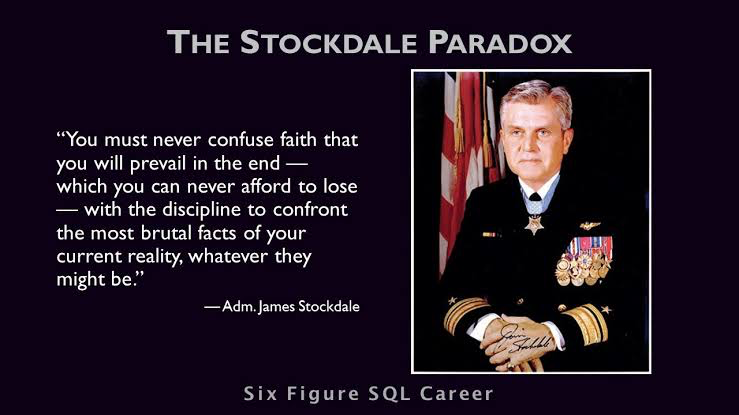
Admiral Jim Stockdale was one of the highest-ranking officers in a prisoner of war camp during the Vietnam War for 8 years. He was tortured over twenty times, and was unsure if he would ever see his family again.
Admiral Stockdale, when captured, told himself he would be there for years to come. He confronted that brutal reality, which allowed him to rationalise the situation he was in.
His doing so let him pioneer communication techniques between prisoners, teach other prisoners how to deal with torture and communicate intelligence to his wife. Had he not been an optimist, he would have given up.
Let's take another example where optimism and reality worked hand-in-hand for great success.
Alan Turing, critical for laying out the foundation for modern-day computers, was also a big reason why WW2 was a success for the Allies.
He had the incredibly optimistic idea of cracking a very complicated encryption algorithm, used by the Axis to communicate war strategies, with the help of many mechanical pieces. He genuinely believed that the technology available to them at the time was able to do such a feat, and therefore, he continuously pursued this objective, even when his colleagues and superiors often thought it was unrealistic.
However, Alan Turing also worked within reality; he made do with the current mechanical constraints, and he didn't just begin to request modern computer parts to be custom-made for his invention. He made this fantastic invention in reality.
This optimism led to one of the greatest inventions of all time, and the reality meant the invention could actually be made.
This balance between optimism and reality is a significant reason why we are living in a free world, not one dominated by Nazis.
Understanding how to balance both optimism and realism is incredibly important to have a successful career, financial life, love, friendships, literally anything you can think of.
I often lean towards the optimistic side. I love being innovative, even if I am constrained by the current situation I'm in, it's a great thought exercise. However, when I'm trying to deliver results, I must also be realistic.
TLDR: Optimists hate the realists, and realists hate the optimists. But both operate in some form of yin and yang and are required for success.
The Prisoner's Dilemma
Trust introduces the best option.
The prisoner's dilemma is one of the first things you learn in game theory, an area of maths that covers the best answer to a situation when playing against two or more parties.
It introduces two individuals, where both have the option to work together (by staying silent when talking to the police), or defect (by talking to the police).
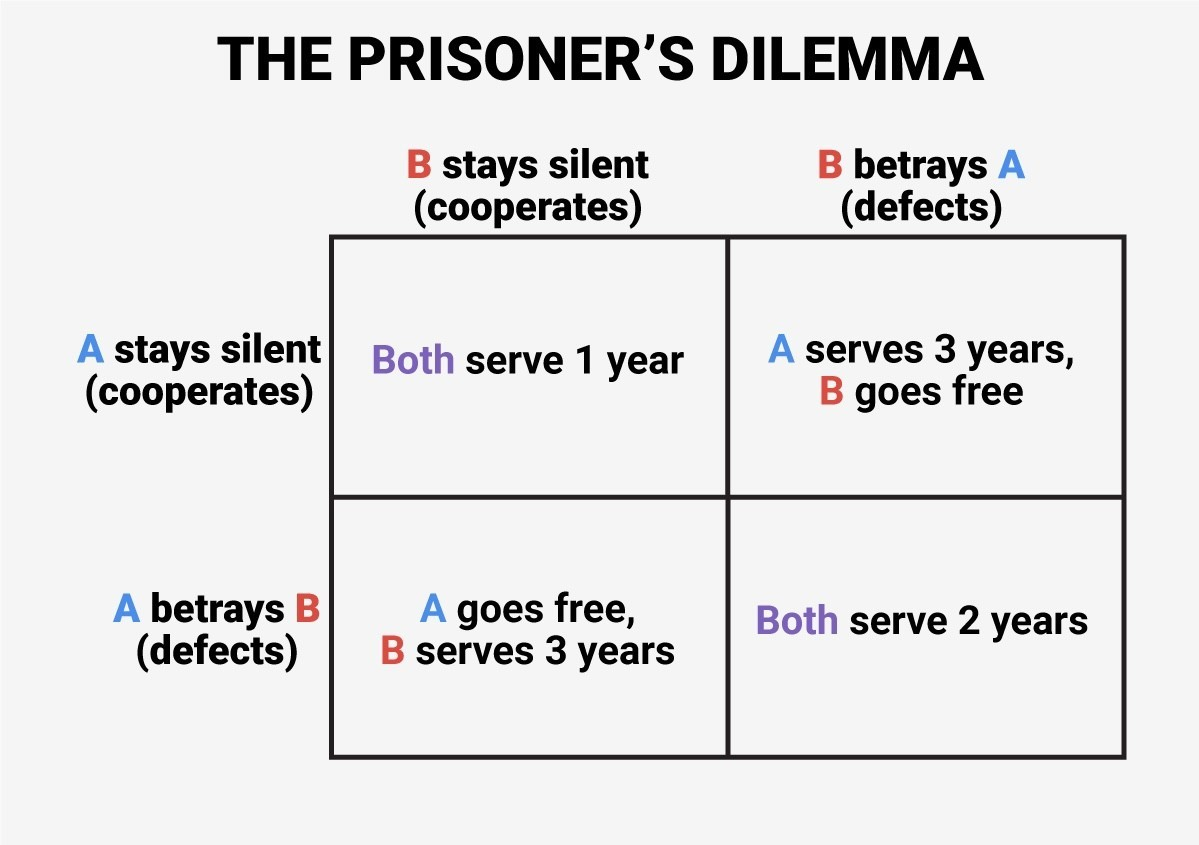
If you were Person A, what would you do?
When considering the prisoner's dilemma, you quickly find out that being selfish and working with the police tends to be the smartest choice when you don't really know the other person. Worst-case, you get 2 years, best-case, you go free.
However, when considering the other player and the fact that you might have a relationship with them, the best outcome is working together to remain silent to the police and only serving 1 year each.
The prisoner's dilemma is an example that shows the importance of having trust between the people you are working with.
Cooperation is often better than being a lone wolf. However, when working in an environment where trust does not exist, you immediately lose the best option, because you are not sure if the other person will betray you.
There are two things I take away from the prisoner's dilemma.
Firstly, establishing trust is in my best interests.
Secondly, where trust cannot be established, being self-interested is a better outcome.
TLDR: When trust exists between the people you are working with, the best way to handle a situation is to work with each other. When trust does not exist, being selfish is the better alternative.
Identity-Based Habits
Your mindset is the biggest barrier to building a habit.
One of the best self-help books I’ve read was James Clear's Atomic Habits.
One of the lessons he taught in the book was the fact that we should build identity-based habits rather than outcome-based habits.
Building an outcome-based habit will be short-lived; you’re just doing it because you have to do it. Because it’s the goal you set. Because it’s what you should do. These habits are not personal and do not hold the same strength that outcome-based habits hold.
With the idea of an identity-based habit, you choose habits that are defined by who you want to be, not what you want to achieve. This is a much better way of setting goals and leads to better success at sticking to habits, because you have defined a why to the habit, not just a how.
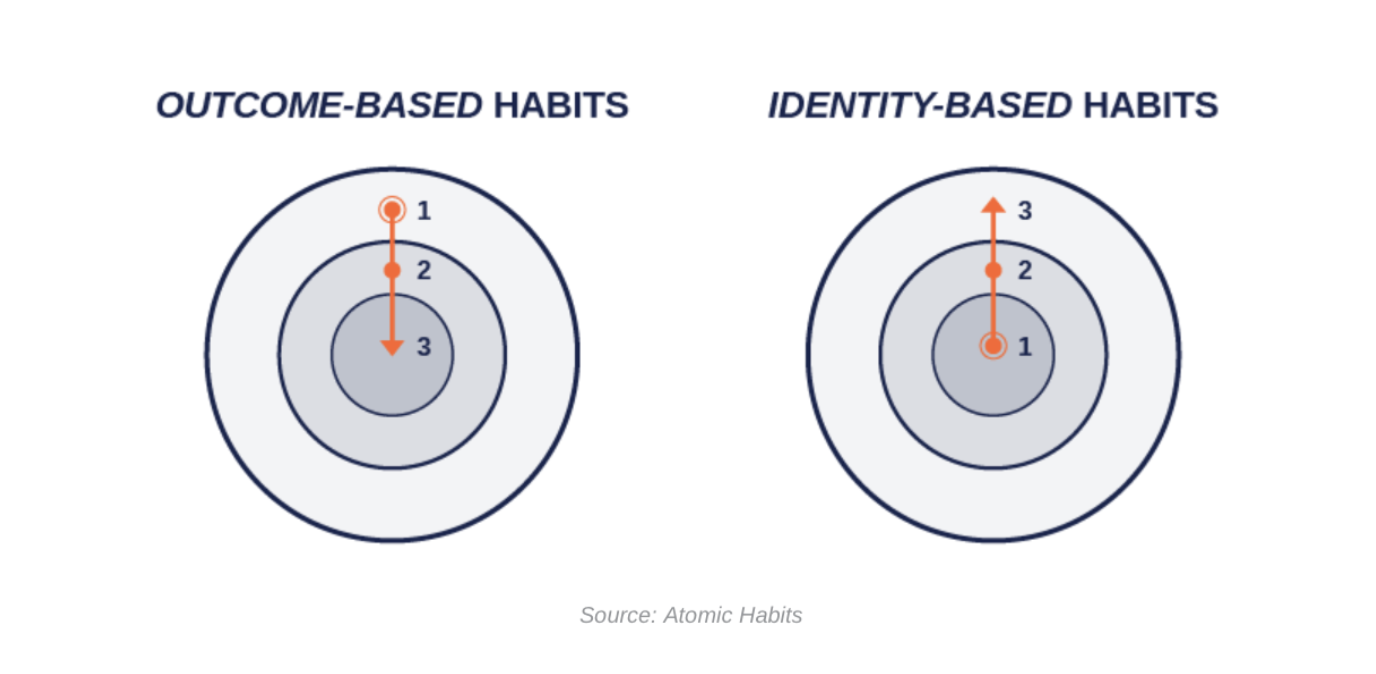
Let’s take a look at an example of both:
- Outcome-based habit: Write 1,000 words every day for my blog.
- Identity-based habit: Become the type of person who wants to write 1,000 words every day for my blog.
It might sound like a very small change, but it is a massive mindset shift.
To pair with identity-based habits, you should also add small wins. Make small incremental tasks that you can achieve sequentially that will allow you to build towards the identity, and eventually, the full habit will come naturally.
For example, writing a paragraph every day would be an example towards writing 1,000 words per day. You can then increase this by a paragraph per week or per month, progressively overloading your habit until you reach your goal.
Firstly, you want to identify what identity you want to build. Next, you must define the small things that build towards this identity. Lastly, you want to slowly progress towards your identity, tracking your progress through those small wins.
TLDR: Rather than setting a random goal, set an identity instead. Envisioning yourself as that future you, it makes you more likely to stick to the habit.
Quotes Of The Week
- “Be yourself; everyone else is already taken.”
― Oscar Wilde - “Two things are infinite: the universe and human stupidity; and I'm not sure about the universe.”
― Albert Einstein - “The person we fall in love with, we hardly ever call by their name. Because it’s somehow just so obvious that it’s you I’m talking to, that it’s you I’m always thinking of. Who else?”
― Fredrik Backman, My Friends