7 Days 7 Lessons #17

- Lesson 1: The Map Is Not The Territory (Decsion Making)
- Lesson 2: Hedonic Adaptation: Happiness Is Always Fleeting (Happiness)
- Lesson 3: Survivorship Bias (Learning)
- Lesson 4: Parkinson's Law (Time Management)
- Lesson 5: Second-Order Thinking (Decision Making)
- Lesson 6: The Mere Exposure Effect (Psychology)
- Lesson 7: The Zeigarnik Effect (Psychology)
The Map Is Not The Territory
Maps are abstractions of territory, just like our mental model is an abstraction of the complex environment we live in.
Every day, the London Underground handles 3.6 million journeys. To put that into context, London has 9.1 million residents as of 2024.
Every day, millions of people look at the tube map, and what they see is an abstraction of reality. The tube isn't a nice set of straight lines underneath London. Instead, they are curved all across the city. Even the distances are a lie!
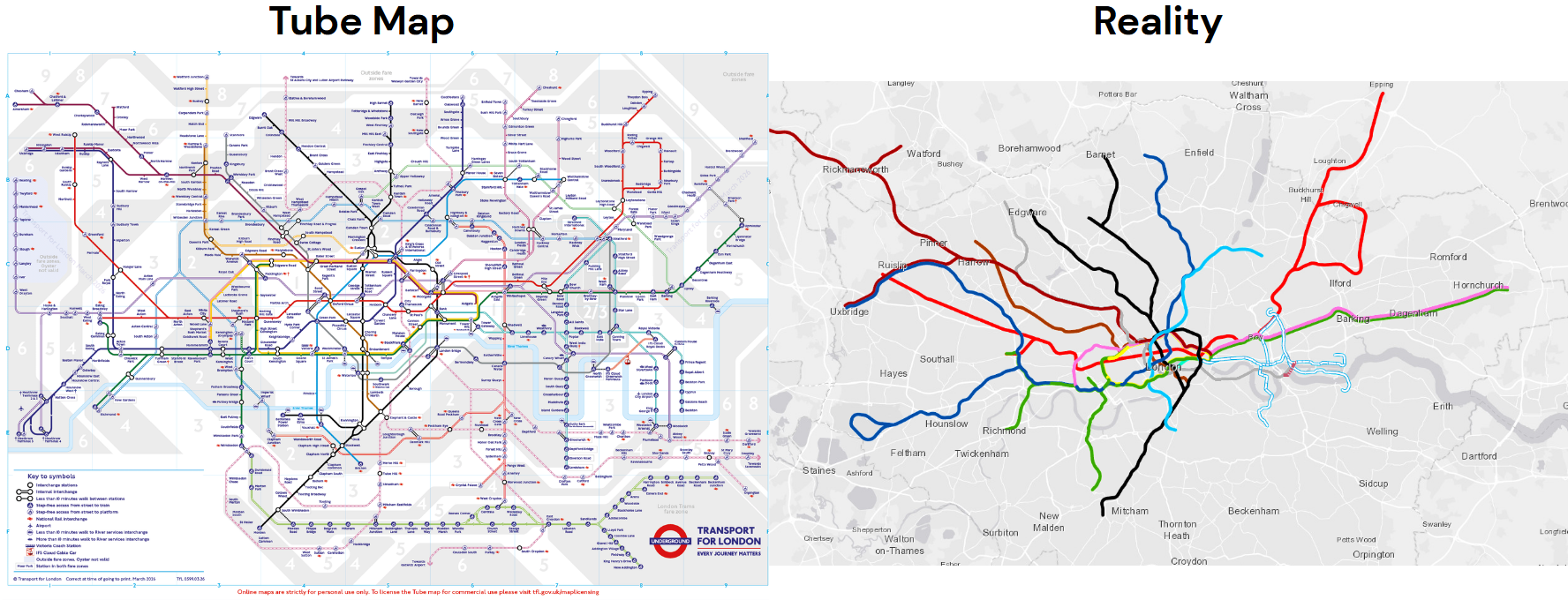
This phrase was first coined in 1931 by Alfred Korzybski. Korzybski argued that human knowledge is not entirely complete; instead, it is a rough estimate of what is actually in the world. Even things we instinctively trust, such as sight, smell, and touch, can often be fooled in the right conditions.
It is impossible to live life in complete reality; we often have to abstract things so that we can manage information. For example, I'll write down documentation at work explaining the main pieces of detail I've been working on rather than having a mini-Lucas on-call. Furthermore, instead of having to attend every meeting, I can read a summary of them using a transcript and understand what is going on from a simplified piece of text.
Maps are incredibly useful; however, we often make mistakes with maps in important decisions. Putting too much trust in a map is like putting trust in a sofa cushioning a fall from 3 stories high. It will try its best, but when the risk is very high, we should use something better.
When making important decisions, we don't want abstractions. We want real, first-hand evidence. We want reality, not what someone else thinks of reality.
I was watching an episode of Diary Of A CEO featuring the Uber CEO. He was talking about how leadership often makes the mistake of getting information from Chinese whispers. For example, an engineer will tell their manager that an experiment failed because of X and Y. But the manager, because of their own motives, may try to cushion this failure. Eventually, it could go back up to leadership as "the experiment is still underway and more work is being put into it".
When it's something trivial like a small feature or a bug fix, this might not be as important. But for a massive feature that could have a big impact on a company, this is simply unacceptable.
This lesson has taught me two things. Firstly, reality is a rich source of information, which should only be called upon when accuracy is mandated; otherwise, you can be quickly overwhelmed.
Secondly, maps are incredibly useful pieces of information that help us accelerate innovation and reduce the load we bear.
TLDR: It's okay to rely on incomplete information as long as the risk isn't too great. But when accuracy is important, it's worth sinking back into reality to see what is going on.
Hedonic Adaptation: Happiness Is Always Fleeting
Satisfaction after completing a task is fleeting. Happiness found along the way is a virtue worth chasing.
I find it hard, almost impossible, to remember a time when I wasn't chasing the next best thing. Whether it was my fiancée, or it was good grades, good friends, a job, a university, an achievement in a video game, a side business, you name it, I can't remember a time when I said enough is enough.
You can probably relate.
This phenomenon is called Hedonic Adaptation, which occurs when the purchasing or experiencing of something new becomes the new normal, and therefore, the happiness that you once received from it disappears.
Philip Brickman and Donald T. Campbell coined the term in 1971, and in 1978, they put their theory to the test.
When looking at lottery winners before and after their winning, they found that the happiness levels returned to normal over time.
Not only is this reflective of positive experiences, but also of negative ones, too. People who had recently become paraplegic also reported increasing happiness over time following their injury.
There are a few reasons why hedonic adaptation occurs:
- Your new becomes normal – After a while, you internally become used to the things you once found novel. Things that you grew attached to become background noise.
- Desensitation – Ever noticed that you stop hearing a consistently annoying buzz in the library after a while of working, but when you start thinking about it again, you begin to hear it? Your brain essentially cancelled it out so that you didn't become overstimulated by the sensation. Similar things happen with happiness and sadness.
- Other things grab your attention – In the first few days, all you can think about is being a lottery winner or a paraplegic. Over time, you begin to focus on other things in life, leading to a stabilising baseline.
These two studies highlight an important lesson. That emotions are seasonal. Good ones will come, and fade away, and so will the bad ones.
Interestingly, studies suggest that you can slow down the adaptation. By appreciating it through gratitude journals or by focusing on it, you slow down the adaptation and get to appreciate the feeling for longer.
Maybe gratitude journals aren't as useless as we once thought. Maybe they help us be less consumer-focused and more appreciative.
My biggest takeaway from this lesson is that we should learn to appreciate the now, as it is a constant in our lives. We aren't guaranteed a future, but we are guaranteed a now.
TLDR: Chasing happiness can often feel like being a hamster in a wheel. That's just how life is. Learn to enjoy the now, the process, and not just the completion of a task.
Survivorship Bias
Only looking at success stories gives you half of the story. The other half is seeing how people have failed.
If your feed looks anything like mine, you probably see a lot of content telling you things like:
- This is how you optimise your life!
- This is how to start a successful business!
- This is how you get a 6-figure job!
Now, I'm not a hater; I genuinely think these people are telling the truth as to how they achieved their objective. However, what the video doesn't show you is the thousands of others who failed to do the same things.
The most popular case study of survivorship bias is the story of WWII planes.
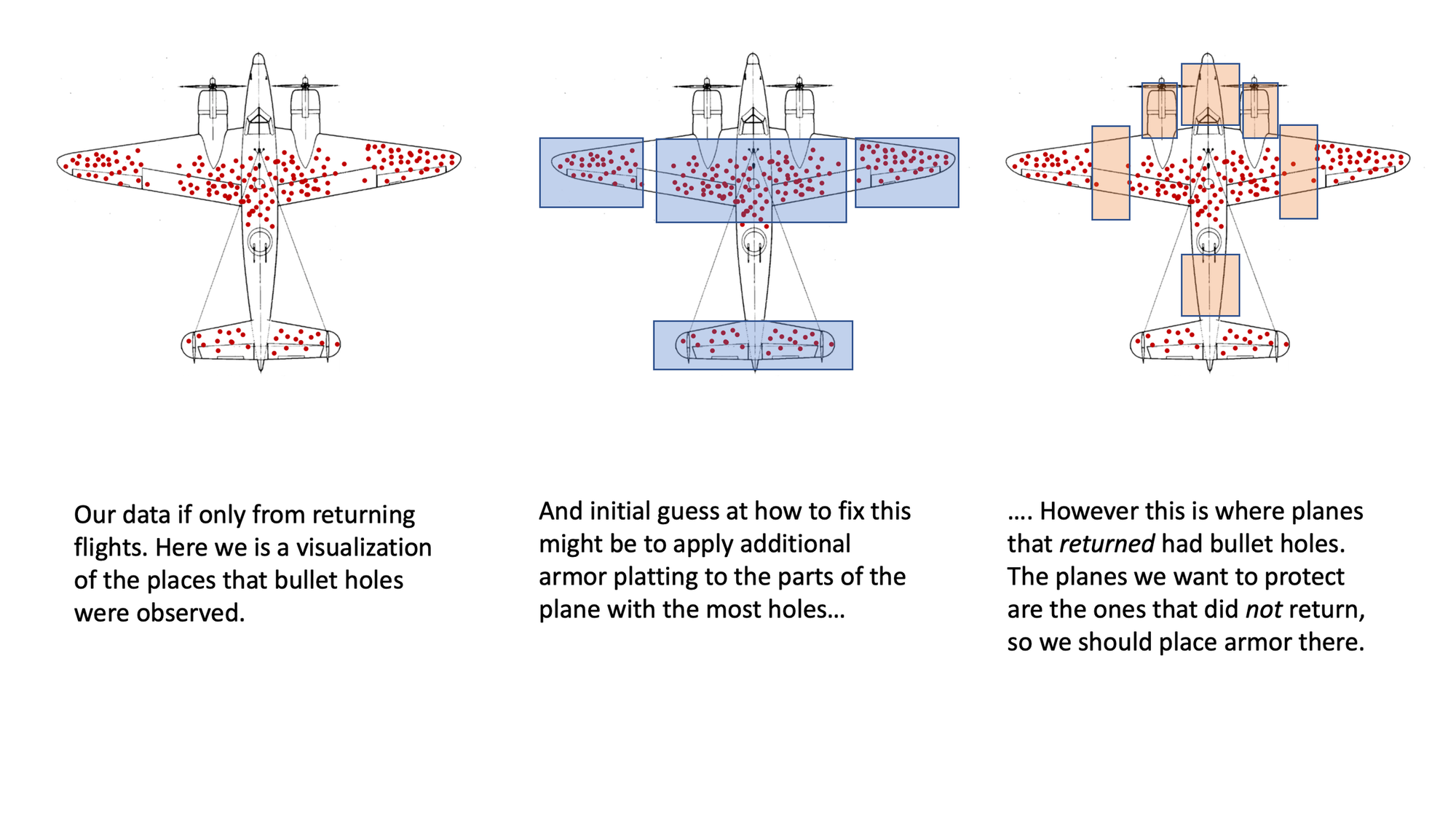
At first, when looking at the planes that have returned from combat, you might think to look at where these planes have been shot and decide to protect them even more.
However, this ignores an incredibly quiet piece of evidence. The planes that didn't return (which arguably have the best evidence to show where to protect) are not included. The winners are trying to tell the story, but the losers have the actual answers.
Instead of reinforcing the areas where the planes were shot at and survived. We should look to reinforce the areas they weren't shot at. If they were, maybe they wouldn't have returned...
Winners don't tell the full story. Winners and losers do. Winners show you things you should do, and losers show you what you shouldn't.
Firstly, I think it's important to see what winners are doing; copying their tips and tricks won't cause much harm. But what is also important to do is keep everything in mind with a pinch of salt. Sometimes, what worked for them won't work for you.
Secondly, I think it's important to find your own way to success. Looking at what others have done might give you some things to try out, but most importantly, it should inspire you to keep trying.
TLDR: Losers are often overlooked when trying to learn something. In most cases, they contain just as much wisdom as the winners.
Parkinsons Law
Stop wasting time and start creating urgency.
When I first started working in cybersecurity, my mentor at the time told me I should get familiar with cloud computing. Understanding this is critical, as most technology is hosted in the cloud. For this, he recommended I take a certification called AWS SAA.
A month after starting, I was confident in what the cloud provided, but I procrastinated taking the exam. It eventually came to the last month I had in the company, and my mentor asked me whether I had sat it yet or not. I didn't. Ultimately, in that same call, we booked it, and we set the exam.
After many push-backs on the exam dates due to a variety of reasons, I eventually did the exam and passed it with flying colours.
Had it not been for setting a date for the exam, I think I would still be pushing the exam back.
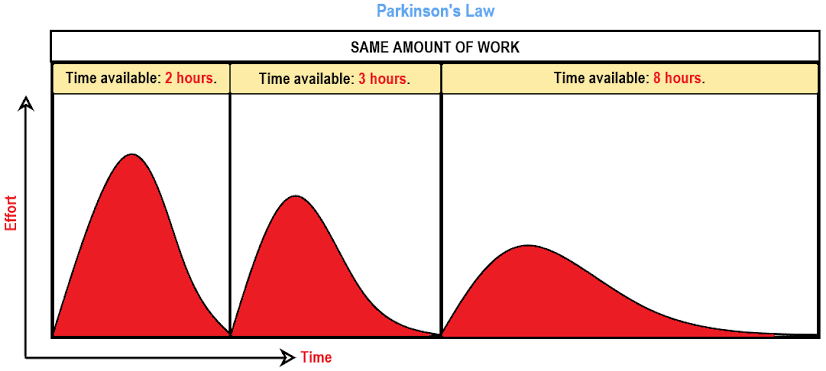
A naval historian, C. Northcote Parkinson, noticed that work expands to fill the time available for its completion.
I find this to be the case in plenty of other scenarios in my life. Setting a deadline, specifically one that is within a short period of time, will mean your work gets done quicker and without sacrificing quality.
I've seen many friends procrastinate their university work until the day before the deadline. I've seen myself write multiple 7 Days 7 Lessons within one day to catch up to the work I'd fallen behind on.
Setting deadlines is not only important to ensure work is completed on time, but also important to ensure work is completed efficiently. Set yourself ambitious but realistic timelines.
There is a balancing act you must strike when setting deadlines.
You don't want it to be unrealistic because if deadlines are too ambitious, you might not complete them on time, which could ruin your reputation, but also your morale.
But you also don't want it to be too flexible, as that will mean a lot of your time is spent doing the same amount of work, but slower.
TLDR: Set yourself ambitious yet realistic deadlines based on your experience. Push yourself, but don't burn yourself out.
Second-Order Thinking
Successful Chess players think multiple moves ahead. You should do the same in life.
Most of my childhood was spent playing video games. It first started with a modded PSP when I was young, moved onto a DS the next Christmas, soon it was an Xbox, and now if I play video games, it's on my PC.
One game I became really fascinated with was called League of Legends. To put it into context, I've put around 3,000 hours into that game, and way too much money alongside it.
A few years ago, when I was trying to really get better at a game (because I'm a hopeless competitive player), I began analysing what the best players were doing.
One common trend was the constant future planning. What would happen if I went to the bottom of the map and helped win a fight down there? Would it matter? Or would it lose me the top of the map, which was far more important? These questions require experience and future foresight to answer.
The same is true for Chess. Grandmasters in Chess can usually look into the future 3-5 moves. That involves analysing 5-10 pieces at a time, and looking 3-5 steps into the future for each one of those pieces, including what the enemy could do. It is a seriously impressive feat.
Hilarious video of one of the best players in chess planning miles ahead in a chess game.
Needless to say, this isn't a skill that is only useful for video games. In fact, it is incredibly useful for handling complex situations in real life.
For example, let's say you are looking to present a product to a potential investor. You want to make sure you've covered all your points. But where most people stop thinking after the first question, those who have more successful investor pitches cover follow-up questions, going deeper as to what could happen after the first outcome.
This is called second-order thinking: what happens after the first thing occurs.
A good technique to handle this can be adapted from the 5 Whys. Instead of repeatedly asking why? Put yourself in the other person's shoes and ask more follow-up questions after the first question you answer. This will help you plan for more situations, ones that could be critical to success in life.
Making decisions can be hard enough, but thinking about the consequences after that decision to the second or even third order will help you decide whether you should take it or not.
Furthermore, being able to plan and cover all potential what-ifs for a plan is incredibly important for a successful career.
TLDR: Most people look at the direct consequence of an event, but fail to think about the future consequences too.
The Mere Exposure Effect
Being constantly exposed to something will probably lead to you liking it more and more each time.
I have the perfectly normal tendency to put a song I really like on repeat when it's first released. I know I'm not the only one doing it, say you do too.
The more I play it, the more I fall in love with it. It always happens. Even with songs that I'm not sure about at the start, the more I listen to them, the more I end up enjoying them.
However, I sometimes overdo it. In one sitting, I once listened to the same song for 2 hours straight. In the end, I lost the strong feelings I once had in the first hour of listening to the song.
This is the mere exposure effect in action.
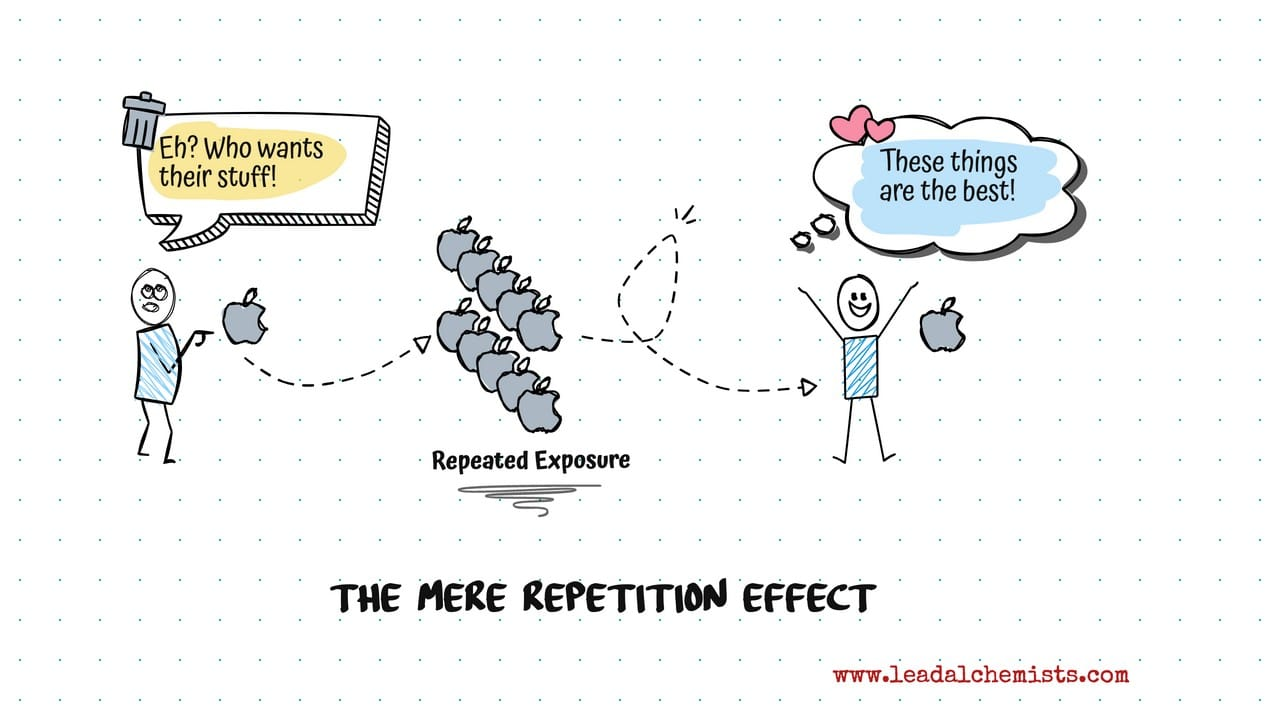
Being fed the same stimuli repeatedly (even without realising it) can strengthen the original emotion you had to it.
That's right, it also works the other way around (going from dislike to hate).
Once you understand this technique, you will come to understand why advertisers place ads everywhere, and it also explains the repeated ads when you're scrolling through social media.
The mere exposure effect is a tool used in the attention economy.
Making a strong first impression now matters more than ever once you learn about the mere exposure effect. The first feeling someone has for you could lead to a much stronger feeling the more they see you. Therefore, maybe you should work on your introduction!
Get a good feeling from doing something you should be doing, such as going to the gym? Go back! Keep exposing yourself to that stimuli (in a sustainable manner) so you can keep up with your new years resolution of becoming the next Arnold Schwarzenegger.
TLDR: Being exposed to the same stimuli over and over again will lead to stronger reactions. Marketers use this technique to grow brand reputation, and you can use this to build long-lasting habits.
The Zeigarnik Effect
Complete a task or throw it out; don't let it idle in your life and consume unnecessary bandwidth.
I have found out the hard way that starting a project and then moving on to another one without completing the previous one is mentally draining. No, mentally debilitating.
I first noticed this when I started working on university projects. If I started a piece of work, I would go at it until I either finished it or reached a point that was agreed upon before starting the work, which would be considered "finished for the day".
If, for whatever reason, I had to stop doing work before I had completed it, I could not stop thinking about it. I wouldn't be present in conversations. I would constantly daydream. I literally could not get it out of my mind. My fiancée knows this all too well.
Until today, I never realised this was a wider problem. I thought I was a unique victim of this.
This is known as the Zeigarnik Effect, which was identified by Bluma Zeigarnik in 1927.
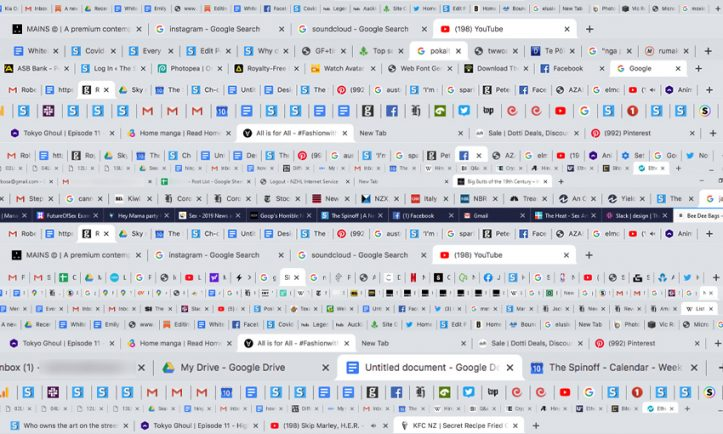
Funnily enough, our brain works very similarly to a computer. Like a computer, if we open up too many projects without closing them, it will lead to our brains running slower and causing mental fatigue.
Knowing this, it is imperative to have a mindset in which you complete a task once it has been started to ensure you do not mentally overload yourself.
I would recommend two techniques if you struggle with the Zeigarnik Effect, both of which I use to offload my memory.
Firstly, you can complete or discard your tasks. This is quite ruthless, but the way it works is by deciding on whether you want to complete a task now/in the next few days or to completely discard it from your life.
Secondly, if you have attachment issues with your ideas, as I do, you can use a task tracking tool, like Jira (or even just your notes app), to store a backlog of your ideas, insert them in there, and completely forget about them until you are looking to decide what you will be doing that week for work.
The idea of offloading your tasks somewhere else removes them from your working memory and therefore frees up your mind for other things, like actually completing work! There is evidence that suggests this to be good against the Zeigarnik Effect.
TLDR: Do not let incomplete work sit there. It clogs up your brain and fatigues it. Instead, decide to complete it or discard it.
Quotes Of The Week
- “Not knowing is a good place to start.”
― Fredrik Backman, Anxious People - “The truth of course is that if people really were as happy as they look on the Internet, they wouldn’t spend so much damn time on the Internet, because no one who’s having a really good day spends half of it taking pictures of themselves. Anyone can nurture a myth about their life if they have enough manure, so if the grass looks greener on the other side of the fence, that’s probably because it’s full of shit.”
― Fredrik Backman, Anxious People - “Nothing is easier for people who never do anything themselves than to criticize someone who actually makes an effort.”
― Fredrik Backman, Anxious People
Authentically Written By Lucas Bernardo