7 Days 7 Lessons #21

- Lesson 1: The Pygmalion Effect (Growth)
- Lesson 2: The Eisenhower Matrix (Time Management)
- Lesson 3: The Peter Principle (Business)
- Lesson 4: Kaizen (Growth)
- Lesson 5: The Availability Heuristic (Psychology)
- Lesson 6: The Locus of Control (Mindset)
- Lesson 7: The Overton Window (World Context)
The Pygmalion Effect
Expectations are powerful influencers.

When I first started working at Sage, my mentor at the time didn't expect to have me. I kind of came out of nowhere, and he didn't really know much about my previous experience.
However, that was probably the best outcome that could have happened. He didn't know my education, experience, or literally anything. Therefore, he didn't try to contain me inside a box.
Instead, he had tasks for me to complete alongside certain expectations, and he assigned them to me. He was available when I needed help, and we were in talks often to ensure I was making the right progress.
In that one year, I learned more about cybersecurity than I had learned in 6 years of being taught computer science.
His expectations formed who I became. learned and grew at a speed I had never achieved before.
The Pygmalion Effect explains what I experienced in my first year at Sage.
The expectations others hold of you directly influence your performance.
The high expectations that my mentor had for me led to higher performance.
In fact, a research paper in 1968 validates this theory.
In an elementary school, teachers were told certain students had high potential because an exam they had taken said so. In reality, the exam wasn't real, and the children were chosen at random.
At the end of the year, the students who had "high potential" meaningfully outperformed their peers.
This impact was driven by their teachers' expectations.
Rosenthal, one of the study's authors, identified four main reasons for this:
- Climate – More attention and positive reinforcement were given to those whom they had higher expectations for.
- Input – More time was spent with the children, and tougher challenges were given to them.
- Output – Students were given more opportunities to speak, answer questions and contribute.
- Feedback – More detailed, constructive feedback was given to these students.
This doesn't necessarily happen intentionally; it happens at a subconscious level.
Firstly, I want to raise a concern. There are a lot of haters in the world, especially at school. Ensuring you and your kids are in a healthy, positive environment is crucial.
I also want to point out that nowadays people have begun to disregard others' thoughts and expectations about them. It is good not to care about what other people's stupid opinions are about you. It is bad to think that other people giving you feedback should be ignored.
This lesson just shows the importance of surrounding yourself with the right people. Expectations are powerful, and surrounding yourself with people who believe in you is critical for success.
Maybe this is why we see a lot of success stories from people brought up in high-expectation families and cultures.
The Eisenhower Matrix
Using your time efficiently requires you to recognise that 'urgent' and 'important' are two different things.
If you've ever bought a planner, the likelihood of you coming across a matrix of urgent and important tasks is highly likely.
Like most people, I never really use it. Not because I think the distinction is unimportant, but I just prefer planning in a calendar or a list rather than a grid.
Nonetheless, the message it conveys is one of extreme importance.
One of the things no one in this world can buy is time, not even those looking to optimise their longevity, such as Bryan Johnson.
This principle was first brought about in one of the best-selling books, The 7 Habits of Highly Effective People, which was inspired by Dwight D. Eisenhower, arguably one of the best US presidents in history. Not only did he manage the D-Day invasion, rebuild post-war Europe, create the US interstate highway system and launch NASA, but he also led the entire country for eight years.
The book argues that this was only possible by recognising one key distinction: urgent and important are not the same thing.
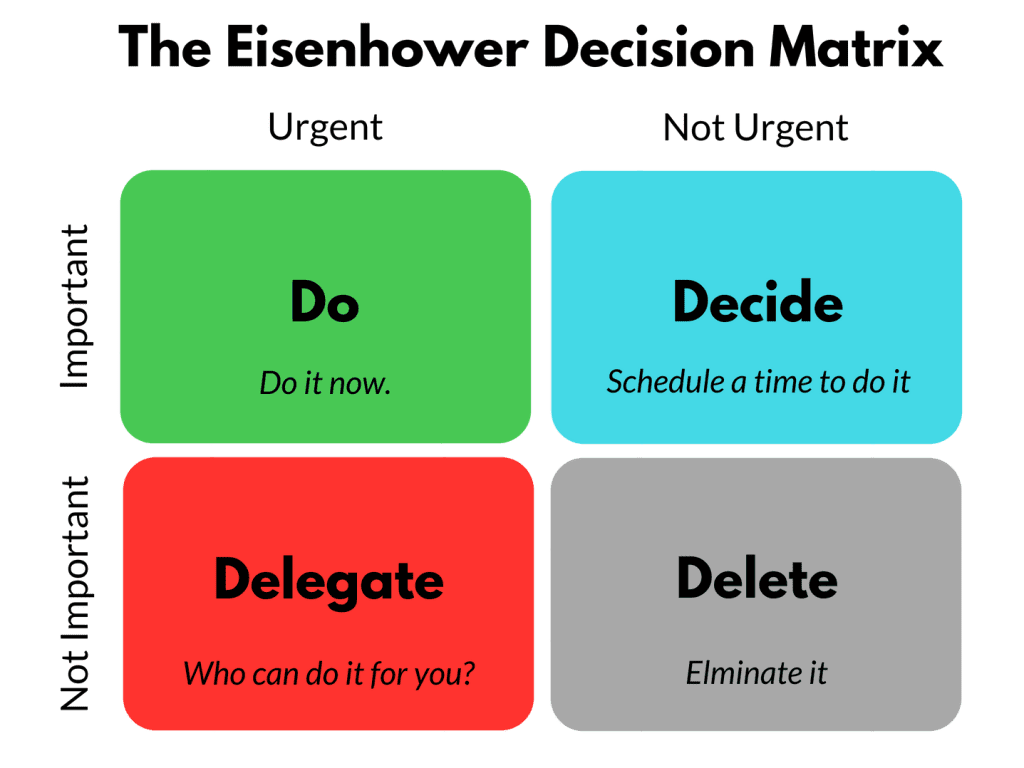
The Eisenhower Matrix is broken into four quadrants:
- Quadrant 1: Urgent and Important - Do it Now. This is anything that must be done ASAP, and is incredibly important to do, and to do it right. This involves tasks such as crises, deadlines, emergencies, etc. Think of your medical problems, university assessments, documentation deadlines, presentations, etc.
It's important to you and someone else. - Quadrant 2: Not Urgent but Important - Schedule it. Maybe you're not in a rush to complete the task, but it must be completed either way. This is something you can schedule. These might include date nights, exercise, writing a business plan, etc.
It's important to you, but you set your own pace. - Quadrant 3: Urgent but Not Important - Delegate it. This is anything that must be completed quickly, but you don't really care about, or you don't value it that highly. This could be emails, meetings, or just random work that could be completed using AI.
It's important to someone else, but not you. - Quadrant 4: Not Urgent and Not Important - Delete it. This is any work that literally adds no value to you, and doesn't have a deadline. This includes things like mindlessly scrolling through your phone or watching TV just for the sake of it.
It's not important to you or anyone else.
The most important thing I want to highlight is Quadrant 2. If you can get on top of your planning, using the Eisenhower Matrix, and make sure that all your Quadrant 2 work is completed, then you will dramatically decrease the amount of Quadrant 1 work you need to complete.
The way I see this lesson is threefold. Firstly, it teaches you how to plan the tasks you need to do: Four simple quadrants, with four simple outcomes.
Secondly, it emphasises that planning is incredibly valuable for success, be it within work or in your personal life. Making sure you optimise the way you live your life means you have the chance to live it more on your own terms.
Thirdly, if you are effectively using the Eisenhower Matrix, or at least its principles, you can reduce a lot of uncertainty and stress from your life, because the amount of Quadrant 1 tasks you need to complete will shrink dramatically. Staying on top of Quadrant 2 is important for the success of this lesson.
The Peter Principle
Instead of being rewarded in their current role, people are rewarded with a promotion, one they are probably not suited to handle.
Imagine this: you are the most talented hacker in the world. You can easily hack into the most well-guarded systems without being detected.
You think that you deserve more money than you are being paid. You keep asking for more money, searching for the same job in different businesses, yet you can't find anything that pays a better salary, one you deserve, whilst still maintaining the same job role.
Instead, you keep getting offered a role in management. Why? Because businesses tend to value management over technical roles. As a result, because you are looking for more money, you take the job.
Suddenly, the world has just lost one of the best hackers in the world, and instead received a sub-par manager.
This is such backwards logic. Yet I've seen this happen many times across different organisations: schools, politics, and businesses.
Firstly, the fact that someone is forced to go into management to get a higher-paying role is ridiculous, especially if they aren't trained for it. You are essentially paying someone more to do a job they are less capable of doing.
Secondly, the fact that businesses are willing to lose good talent just to gain mediocre managers, in order to provide the pay bump, is outrageous. It is a waste of money and talent.
Bureaucracy is what causes this sort of business inefficiency.
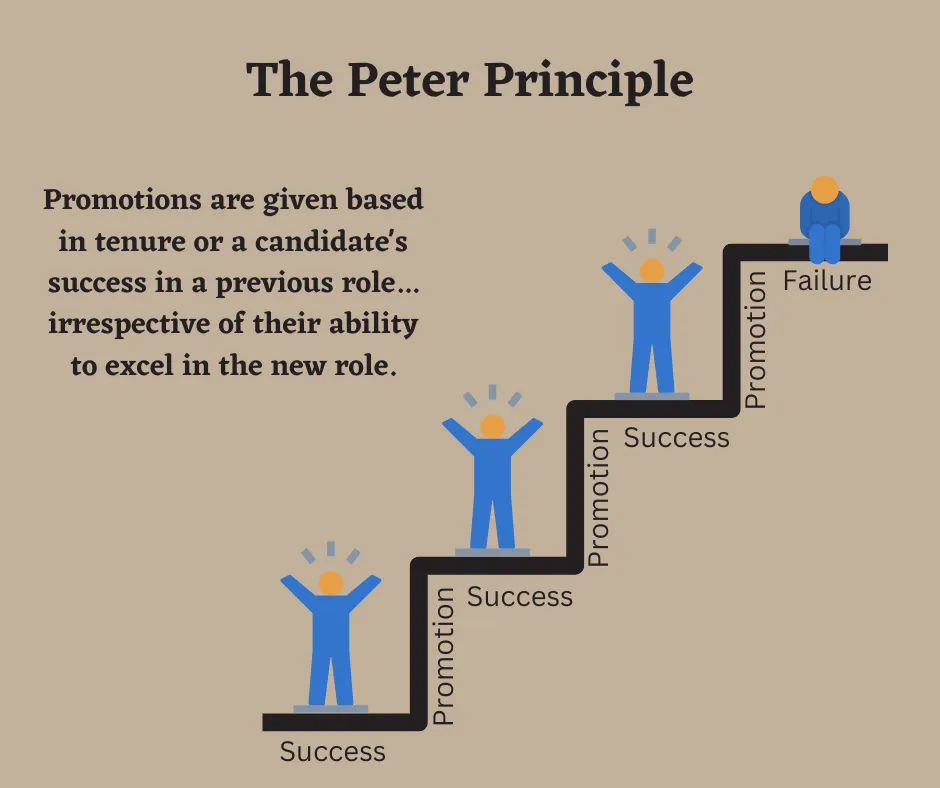
This is the Peter Principle in action, an observation first made by Laurence Peter in 1969, where he noticed that people would be promoted until they eventually landed in a job, such as management, and made no more progress because they weren't good enough.
Organisations that cannot justify paying a technical worker more money and instead promote them into a management role ruin the future prospects of that individual, and cause the world to lose their talent.
Organisations have three goals when it comes to employing people.
Firstly, it is their duty to train them and put them in the right environment for success.
Secondly, organisations should reward their employees well for the work they do.
Thirdly, organisations should hire based on merit and nothing else.
Most organisations fail on the second and third points. They don't pay their talent well enough, which means they are more likely to leave. They also promote employees into positions not based on merit, but based on rewarding the individual.
Kaizen
The Japanese word for "Change for Good".
This is my 21st week writing 7 Days 7 Lessons. What I've found interesting is that a small majority of lessons involved small changes leading to massive/beneficial improvements.

Kaizen describes this philosophy. It is the discipline of making small, continuous improvements every day.
It originates partly from America. After the Second World War, the US sent management consultants to Japan to help rebuild its industrial economy.
One of them, W. Edwards Deming, was a statistician who continuously pushed for incremental improvements in processes and quality.
One of the biggest success stories was Toyota, a small manufacturing company at the time that grew because of this philosophy.
Toyota is arguably one of the best case studies in business, with plenty of success stories to its credit, such as Lean Manufacturing, the 5 Whys, and the Toyota Production System.
Regardless, Toyota is arguably the best representative of Kaizen. They adopted this change by having employees suggest one small improvement to implement by the next day.
Eventually, Toyota became the largest car manufacturing company in the world and still holds that lead.
There are more success stories of Kaizen, such as that of the British Cycling team. Sir Dave Brailsford was handed control over British Cycling in 2003. They had only one gold medal in 76 years.
Eventually, Brailsford introduced a technique called the aggregation of marginal gains, a spiritual successor to the Kaizen philosophy. This could be in training, nutrition, sleep, etc. By 2008, the British Cyclists won seven of the ten gold medals available in the Beijing Olympics.
One thing is clear from the 147 days of doing this series. Small changes are the most underrated drivers of success.
The other day, before I even started looking at this lesson, I started highlighting two things at the end of every day.
Firstly, what went well. It doesn't have to be a list of things; it just has to be one item, one thing in my day that went well. I want to have that recorded so that I can repeat it as soon as possible.
Secondly, what could have gone better? Again, it doesn't have to be a list. Just one item, such as "I wasn't able to go to the gym today as I had expected to go".
From these two things, I acknowledge the good I've done, and I do my best to complete the "what could have gone better" task the next day.
It's the small things in life that often need change, not the big ones.
The Availability Heuristic
The bias that links our sense of probability to how easily we can recall an example.
My fiancée is training to be a doctor. Not long left! Either way, something that she and others commonly do is associate a symptom they have with something they have recently learned.
For example, you've got a headache, and all of a sudden, you think you have a brain bleed!
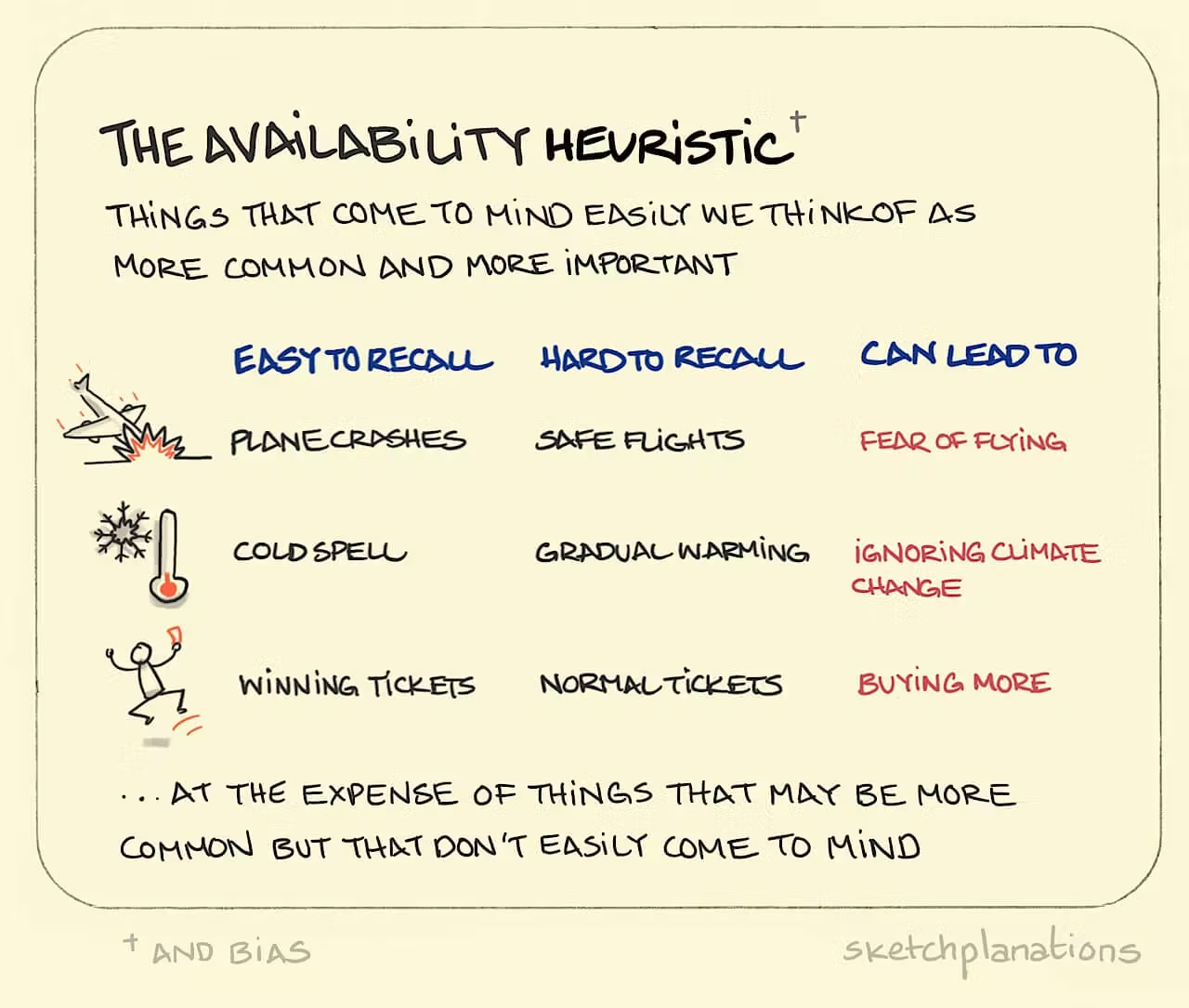
This is a common thing that med students and even doctors, go through. This is a clear example of the Availability Heuristic.
The Availability Heuristic is one of the many mental shortcuts we make. This one specifically skews our sense of probability into how quickly we can think of an example of it.
For example, having a headache could just be that, but it could also be a brain bleed, and because you recently studied brain bleeds, you think you could be one of the rare cases of developing a brain bleed without having been in a traumatic accident.
This bias, although useful in certain instances such as preventing yourself from repeating a traumatic event, smudges the facts. Specifically, probability.
Being able to separate bias and emotions from objective facts is a critical skill to develop, and understanding the Availability Heuristic is a step in the right direction.
During the digital era, social media and the news cycle can exacerbate this bias even more. Algorithms and repeated content can lead us to a distorted picture of reality.
Furthermore, this bias can also prevent you from making good choices, such as investing in digital technologies after the dot-com bubble.
Understanding why something went wrong the first time can help us develop a less generalised version of the Availability Heuristic instead of a catch-all that could negatively affect our lives.
The Locus of Control
Do you have control in your life, or do you outsource it to other people?
In most cases, I blame myself for failing or for being in the circumstances I'm in.
Of course, certain things I can't really change. I have asthma, which isn't something I can choose not to have, but regardless, in most cases, I put it on my shoulders, and nobody else's.
I've spoken about this topic briefly before. To me, the idea makes sense. I am the common denominator in my life, and so if I can't get a job, or I'm struggling with something, it is my fault, and I've got to figure it out.
Maybe that's upskilling, or maybe it's seeking help. But if I don't do something, the chance of someone else helping me is slim.
As a result, you would say that I have an internal locus of control. I believe that my outcomes are primarily determined by my own actions, decisions, effort and character.
However, on the flip side, someone might have an external locus of control. They believe that outcomes are primarily determined by forces outside their control, such as the government, economy, fate, luck, etc.
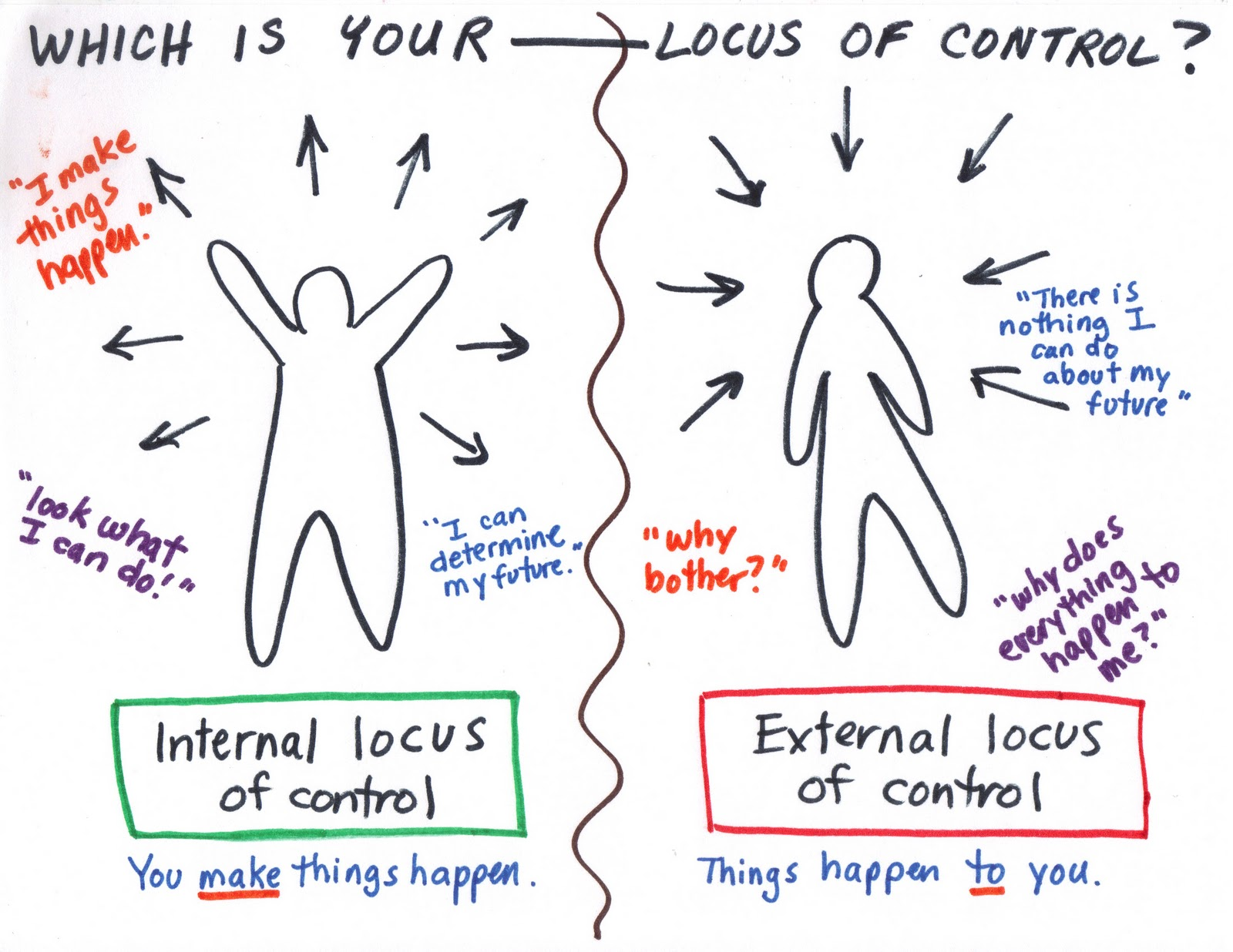
Unlike most people who speak on this topic, I will acknowledge that both are valid ways of living.
But for me, I don't want to outsource my autonomy, agency, or potential to external forces I cannot control. As a result, the choice is simple for me: to live a life where I have an internal locus of control.
In fact, a meta-analysis of over 40 studies suggests that those with a more internal locus of control consistently achieved higher grades, regardless of their measured intelligence. These students were more likely to study harder, seek help, and persevere through difficult times.
So I leave you with one question. Is it easier to change yourself or those around you?
Honestly, I cannot convey just how good life has been since adopting this mindset. Maybe it was coincidental, but anecdotally, it has been great.
Since then, I've tried to tell more people to adopt this mindset, to show them that they are in control. Those who have adopted it have seen real changes.
Life doesn't get easier when you adopt this mindset, but it does come under your control, which reduces anxiety and stress. Give it a try, and see what happens.
The Overton Window
Who decides what is acceptable to discuss?
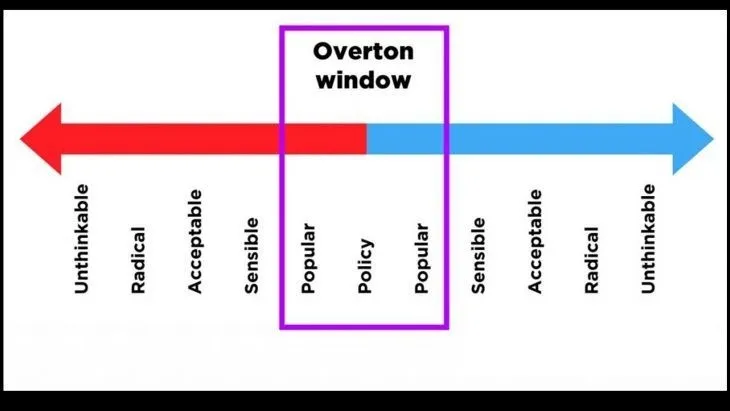
The Overton Window, named after Joseph P. Overton, describes the range of ideas that are considered acceptable to discuss in public.
For example, incredibly divisive issues would not be considered to be inside the Overton Window, such as politics, religion, or essentially anything that would be banned for discussion during a family dinner.
But something like the weather, although mundane, would be.
One important characteristic of the Overton Window is that over time, the window can move and include previously undiscussed topics.
One example would be working from home. Before 2020, working from home was considered a luxury. After COVID, when entire countries were shut down, this became mandatory, and now it has become normalised, even if companies are trying their best to force workers back into the office.
An emerging one is Universal Basic Income. What was once considered an incredibly socialist policy that those who opposed it wanted nothing to do with is now looking like a more realistic safeguard against a potentially devastating labour market event caused by Artificial Intelligence.
To be clear, the concept is not a law or a matter-of-fact. Instead, it is a descriptive model, one that describes what is going on.
During the increasingly divisive times we are living through, understanding the Overton Window gives you context and a framework for navigating the world.
We live in probably one of the most divisive times in recent history. V-Dem, a Political Polarisation Score, is a way of tracking the divisiveness between opinions in countries, which has been increasing rapidly across the world after reaching an all-time low in 2000. The United States has seen one of the fastest-growing scores across the world.
The Overton Window teaches two important lessons.
Firstly, it teaches empathy. What is allowed to be spoken about vs. not is continually changing, and because of this change, people should not be berated for their opinions. Living in democratic countries allows for the freedom of ideas. For this freedom, we have the unintended consequence of bad ideas, but that is a price worth paying.
Secondly, for those who are looking to navigate the world whilst causing as little drama as possible, this puts into perspective what should be spoken about and what should be quickly deflected.
Quotes Of The Week
- "Those who don't know history are doomed to repeat it." ― Edmund Burke
- "Life can only be understood backwards; but it must be lived forwards." – Søren Kierkegaard
- "There are more things likely to frighten us than there are to crush us; we suffer more often in imagination than in reality ." – Seneca
- "Change your thoughts and you change your world." – Norman Vincent Peale
Authentically Written By Lucas Bernardo