7 Days 7 Lessons #20

- Lesson 1: Solomon's Paradox (Wisdom)
- Lesson 2: The Cobra Effect (Problem Solving)
- Lesson 3: Hormesis (Growth)
- Lesson 4: Temptation Bundling (Habits)
- Lesson 5: Occam's Razor (Decision Making)
- Lesson 6: The Lindy Effect (Prioritisation)
- Lesson 7: Memento Mori (Life Context)
Solomon's Paradox
We are annoyed when others don't take our advice, but we make excuses for ourselves when we do the same.
Imagine you have a child, or a dog, or just anything that is dependent on you.
It suddenly falls ill, and you need to make sure it's taking the right medication, it's getting enough physical activity, and it's on track to make a speedy recovery.
You would do all you could to ensure a speedy recovery, wouldn't you?
Now, instead of it being a dependent, replace it with yourself. Would you do the same for you?
From my lived experience and from those I know around me, the most probable answer is no.
We are so quick to want to help others that we forget we need to help ourselves first.
I'm not special; I fall victim to this paradox all too often. The most obvious one is related to 7D7L.
Every week, I sit down for around 7 hours to research lessons and write them up for myself and others who might read them, in the hope that those who apply them will see their benefits.
But I don't always apply them myself.
I'm so determined to see others do well, to treat others with better care than myself, that I neglect myself in the process.
Solomon's paradox describes this idea perfectly. King Solomon was one of the wisest people to have ever lived. People travelled long distances to hear his wisdom, yet when it came to applying it for himself, he often fell short.
King Solomon had uncontrolled passions, made reckless decisions, and ultimately failed to prepare his heir, leading to the collapse of his kingdom.
Maybe if we took care of ourselves and used the same wisdom we gave to others, the world would be a better place.
There's no better word to describe this than being a hypocrite.
No one wants to be one, but when it comes to giving and taking advice, we suck.
The best way to counteract this is by thinking of yourself in the third person. This helps you keep an objective lens.
You can also ask yourself, "What would I tell a friend?" and do what you would say to a friend.
The Cobra Effect
A solution is not the only thing you must consider when solving a problem. You must also consider its repercussions down the line.
Imagine you want to get more physically fit. You decide that the way you will tackle this problem is by treating yourself to a McDonald's after a workout.
At first, you are continuously going to the gym, and you are making good progress, at least when it comes to maintaining the habit. However, as you keep weighing yourself every day, you realise that you've been gaining more fat and less muscle mass.
A few friends and I used to do this when we were back in secondary school. Although we were regularly going to the gym, we were not getting fitter. This was because the calories we lost during our gym session were gained right after our reward for entering the gym.
In hindsight, this was obvious, but we never thought about it.
The Cobra Effect explains that a solution to a problem may cause additional problems down the line, which could ultimately hinder the original goal or create new problems.
It was coined by Horst Siebert in 2001, based on an anecdote from the era of the British Raj.
In the story, the British colonial government in Delhi were alarmed because of the high number of venomous cobras in the city.
Therefore, as most people would suggest, they put a bounty on each cobra.
At first, it was going quite well, but after a while, people found a loophole in the system. You could just breed the cobras and create an infinite money glitch.
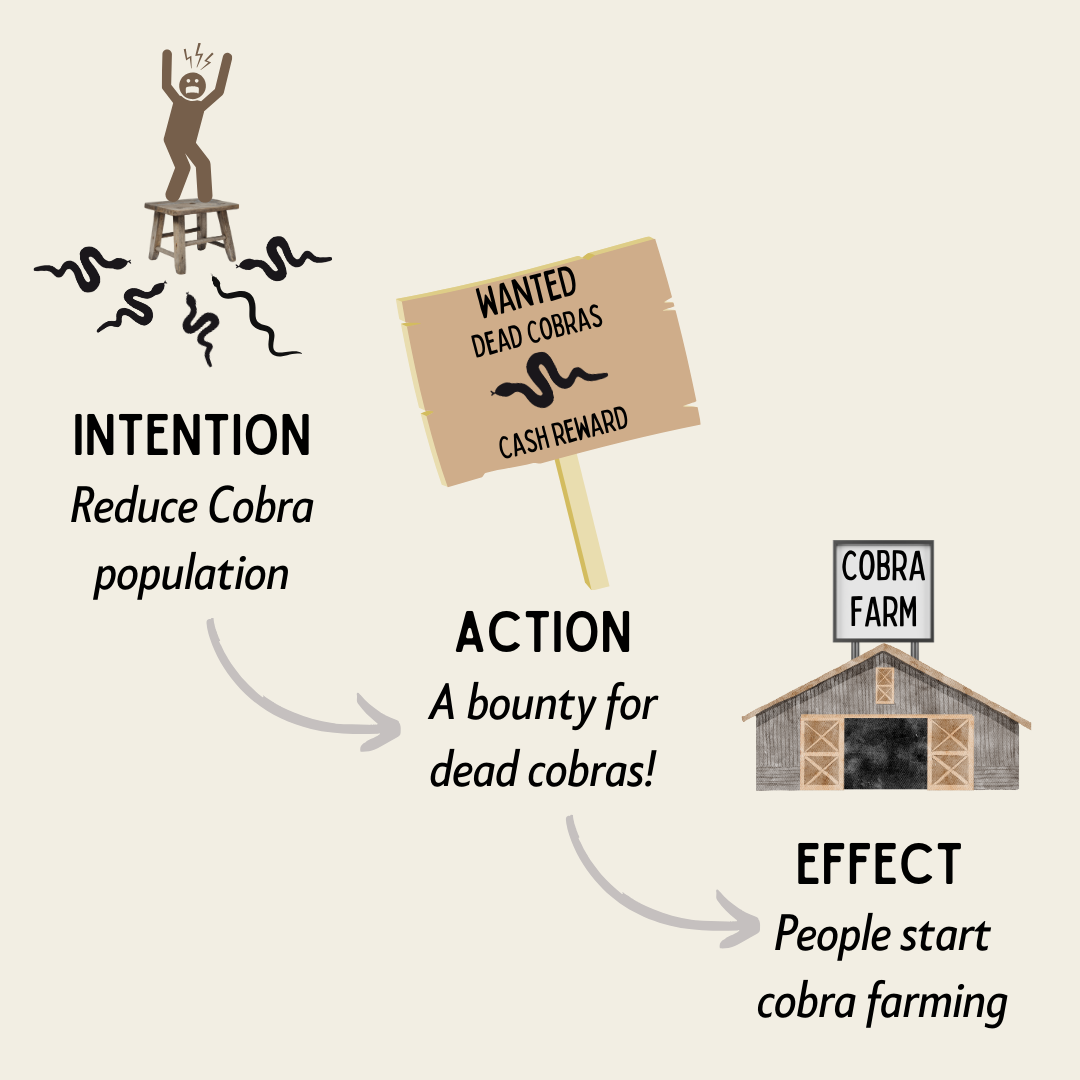
The result was that there were more cobras in the city than before this bounty was placed.
The solution, which at first seemed logical, made the original problem much worse.
This lesson is incredibly important to be aware of. Our employers hire us because of our ability to solve problems.
However, not all solutions carry the same weight. They may all solve the initial problem, but they may have unintended consequences that must be thoroughly examined.
Your job is just as much about critical thinking as it is about solving problems.
Hormesis
A small amount of stress is necessary for progress.
I've started going to the gym much more consistently recently. I've set out a few goals I want to achieve, and therefore, weight and cardio training are currently what I'm focusing on.
Whenever we go to the gym, we put our bodies under stress. This stress can look like us being out of breath, feeling sore, and just being tired.
That brief period of stress, however, is what allows us to make progress. It's what builds our resilience and makes us stronger in the process.
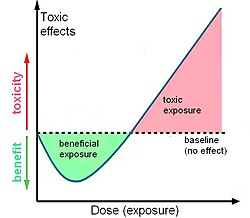
Hormesis is a biological phenomenon where a low dose of something can trigger many beneficial responses.
The gym is one example of that, but so is the vaccination process.
One of the most common types of vaccines is the insertion of an almost dead or weakened version of a virus into your body, which allows your immune system to find the secret formula to defeat it by itself.
This small dose of "bad" has led to a much bigger response of "good".
Okay, this is all fine and dandy, but how is this helpful to me outside of health?
Well, this phenomenon can be applied to many different areas of our lives.
For example, maybe you are trying to learn how to code. It requires you to go through a short period of stress to permanently unlock the knowledge that will get you through life.
Or maybe you are trying to build a new habit, such as writing. By setting the goal of writing every day, even if it's just one sentence, you are showing your body that you are a writer and, therefore, you are more likely to do it.
Throughout my lessons, I've mentioned a few times that it's the small amount of stress that leads to the biggest amount of change. The same is true in biology.
It's important to remember that a small amount of stress is useful for growth, but too much stress is damaging to your health. Moderation is key.
Apply this principle to the life you live. What are the small things in your life that make you uncomfortable, that you could introduce into your life to make you a better version of yourself?
Temptation Bundling
Rewards are a powerful incentive for hard work.
Building a habit is effortful and most of the time sucks. I've been on and off at the gym so often that I frankly can't remember a time I was consistently going.
Don't get me wrong, I know why I should be going, it's not like I haven't heard people give me pep talks before, telling me why going to the gym is healthy and why I should do it for my future self. The problem is that it doesn't really encourage me anymore like it used to.
That's not to say that motivation from understanding is bad; in fact, it's good, and I've spoken about identity-based habits before, an idea based on James Clear's book Atomic Habits.
However, other things can help you stick to a habit. One technique is called Temptation Bundling.
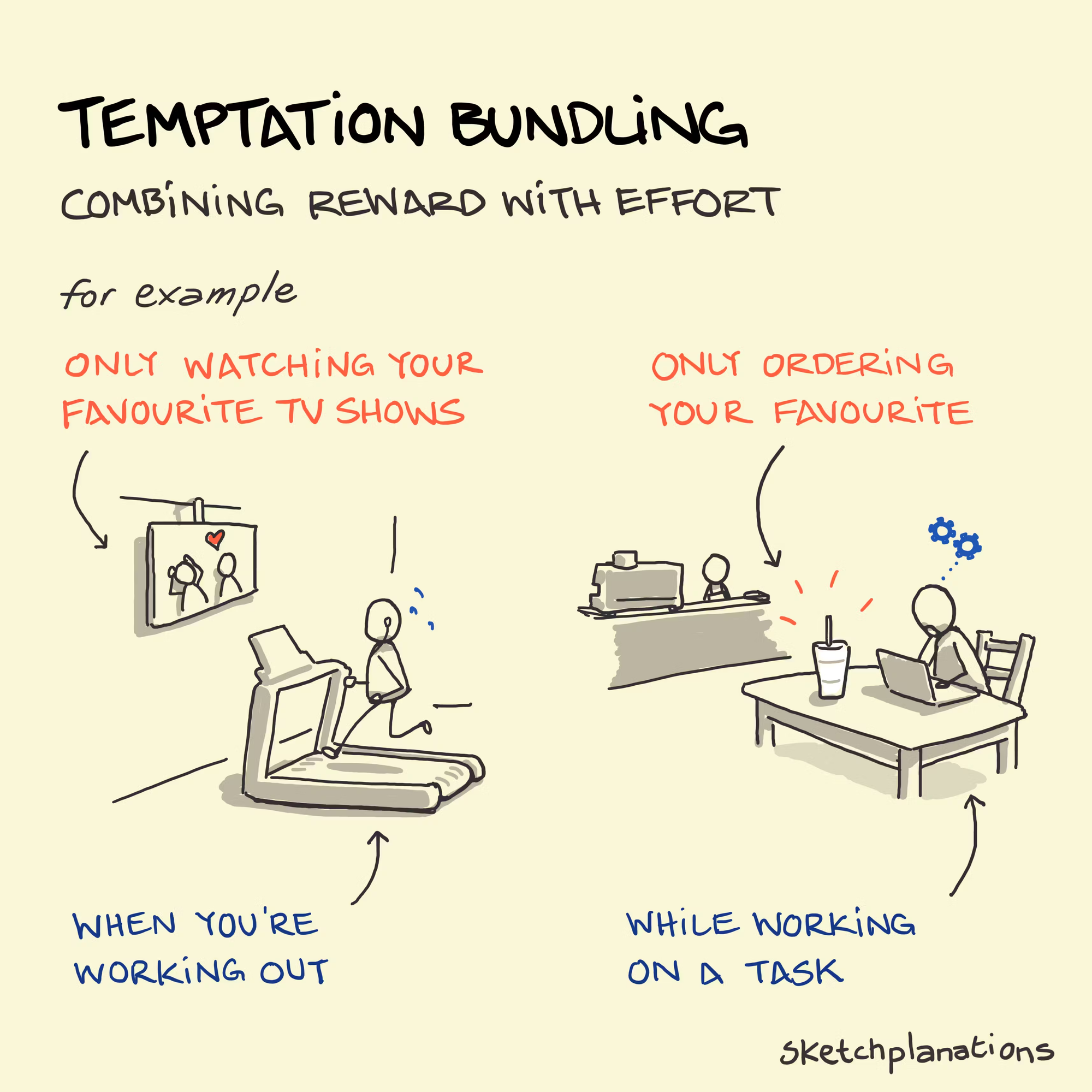
The name doesn't really give a clear indicator of what it does, but essentially, it's about rewarding yourself with something you've wanted to do, but only after you have completed a task you need to do.
For example, I'm currently trying to rebuild my gym-going habit. At the moment, I have two rewards: feeling good about myself because I'm up before most people, at the gym, working hard. But I'm also listening to something entertaining whilst at the gym. Sometimes it's a book, or sometimes it's a podcast; either way, it makes me feel twice as productive, because I'm exercising and being entertained!
It seems quite straightforward and, in fact, a bit stupid. At first, when I tried implementing something like this into my life, I thought to myself, "I can just break this imaginary rule whenever I want; how on earth is this going to help?"
The secret to making this technique useful was one statement.
If I can't trust myself to show up and be truthful, why should anyone else believe me?
That context made me want to be accountable and follow the imaginary rules I've set myself.
Having a variety of different rewards is crucial. You don't want to be indulging in only one reward, as that can create a problem of its own (for example, giving yourself a sweet every time you complete a task is not a good idea).
Things I supplement my shoulds with include sweet treats, entertainment (games and videos), purchases, etc.
Just as it is important to reward yourself for the hard work you've done, it's also important to ensure the reward is justified. Buying a £50 game every time you do your homework is not a fair trade.
Occam's Razor
Side with the more straightforward answer if it is still grounded in truth.
I can't believe I'm talking about Occam's Razor. After many years of studying biology and computer science, I really didn't expect to be writing about it.
But I think it's a very useful principle that can help people reason and think critically during a time when doing so is never the first option.
Occam's Razor states that if two explanations are equally logical but one requires more assumptions than the other, you should take the simplest explanation until it is no longer adequate.
Occam's Razor isn't about forcing you to believe something simple but untrue. Instead, it argues that you should believe the simplest reason grounded in truth until it no longer holds.

Why is this important? Because assumptions are not facts. Assumptions are like the window game in Squid Game. Sometimes they hold, but sometimes they collapse, and you can't tell until, too late. One glass breaking would be catastrophic. Therefore, basing your reasoning on as few assumptions as possible gives the strongest hypothesis.
Sometimes, the best hypothesis is the simplest one.
Occam's Razor is becoming more and more important as people begin to theorise on things that require multiple assumptions. Conspiracy theories are being believed now more than ever, groups of people are being vilified based on tons of assumptions, and all of this is causing an unstable environment in which to live.
Occam's Razor is infinitely more important now during a time when critical thinking is at an all-time low.
The Lindy Effect
The age of something is a good indicator of its life expectancy.
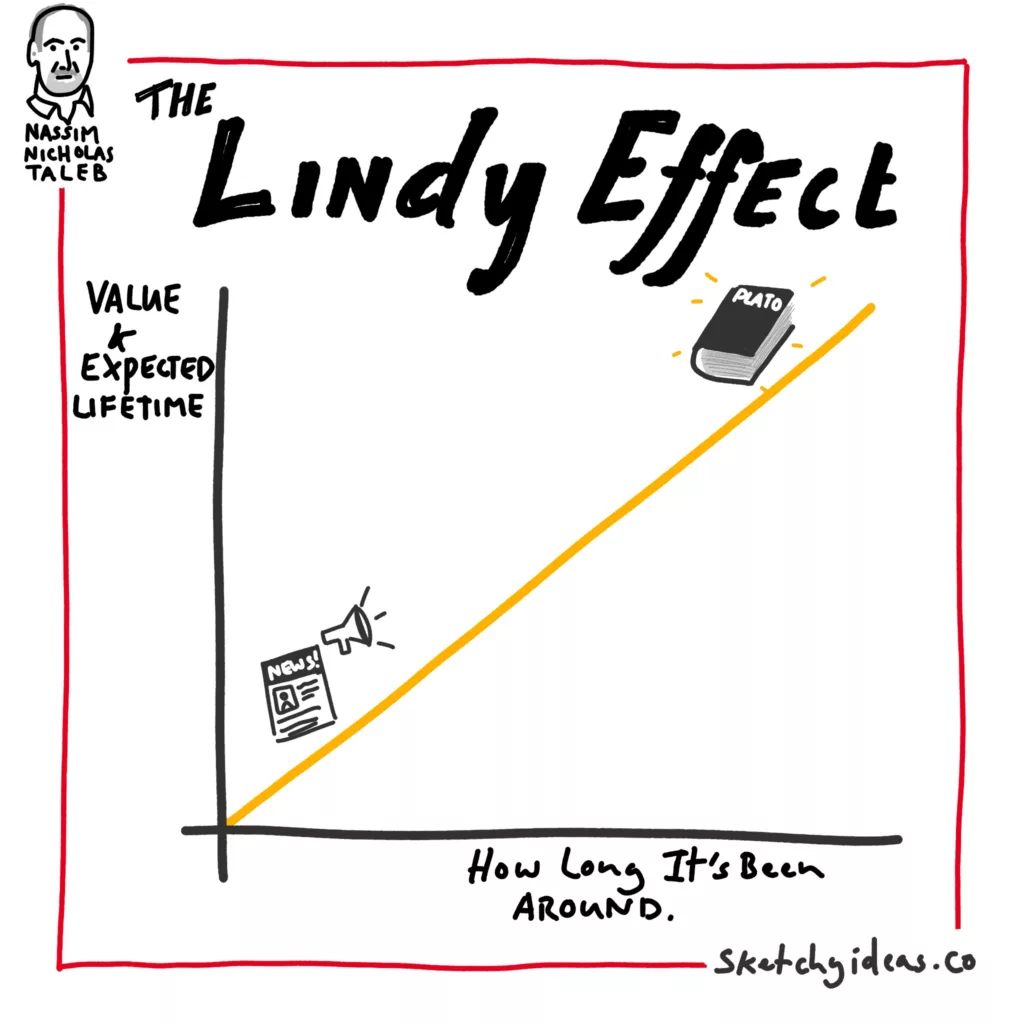
The Lindy Effect dictates that non-perishable objects, such as ideas, books, and movies, age in the opposite way that perishable objects do.
For example, as a human gets older, this will mean the probability of them dying increases.
This is not the same for most non-perishable objects, such as books. For example, if a book has been in circulation for a long period of time, the likelihood of it remaining in circulation for longer is high.
Take the Bible, for example. The fact that it has been around for 2,000 years suggests that it will last much longer than that unless something drastic happens.
This is because it has been resistant to change, obsolescence and competition. Its very survival suggests it will survive longer.
Of course, this could change if the majority of the Christian population suddenly went extinct, or if the Bible were proven to be false.
This term originates from Lindy's delicatessen in New York, where Broadway insiders noticed that longer-running shows were expected to run even longer.
Albert Goldman wrote about "Lindy's Law" in 1964, and Nassim Nicholas Taleb popularised it in his book Antifragile in 2012.
There is also one piece of research that strengthens this observation. Physicist Richard Gott tested this by making a list of Broadway shows on a single day, 17 May 1993. He then predicted that the longest-running ones would last the longest. The accuracy of his prediction was 95%.
There are many ways you can apply this to your everyday life. For example, it demonstrates the strengths of incumbents in an industry. Take Berkshire Hathaway, Coca-Cola, Lego, Nintendo, etc.
You can also use this idea to decide how to prioritise things to consume, such as movies, books, and games. The ones that are the most popular, even to this day, are likely to be very good.
Finally, the same applies to philosophical laws and lessons, such as the ones I write about. If a concept has existed for a century and is still being spoken about, it is likely to be a good lesson.
Memento Mori
We all eventually die.
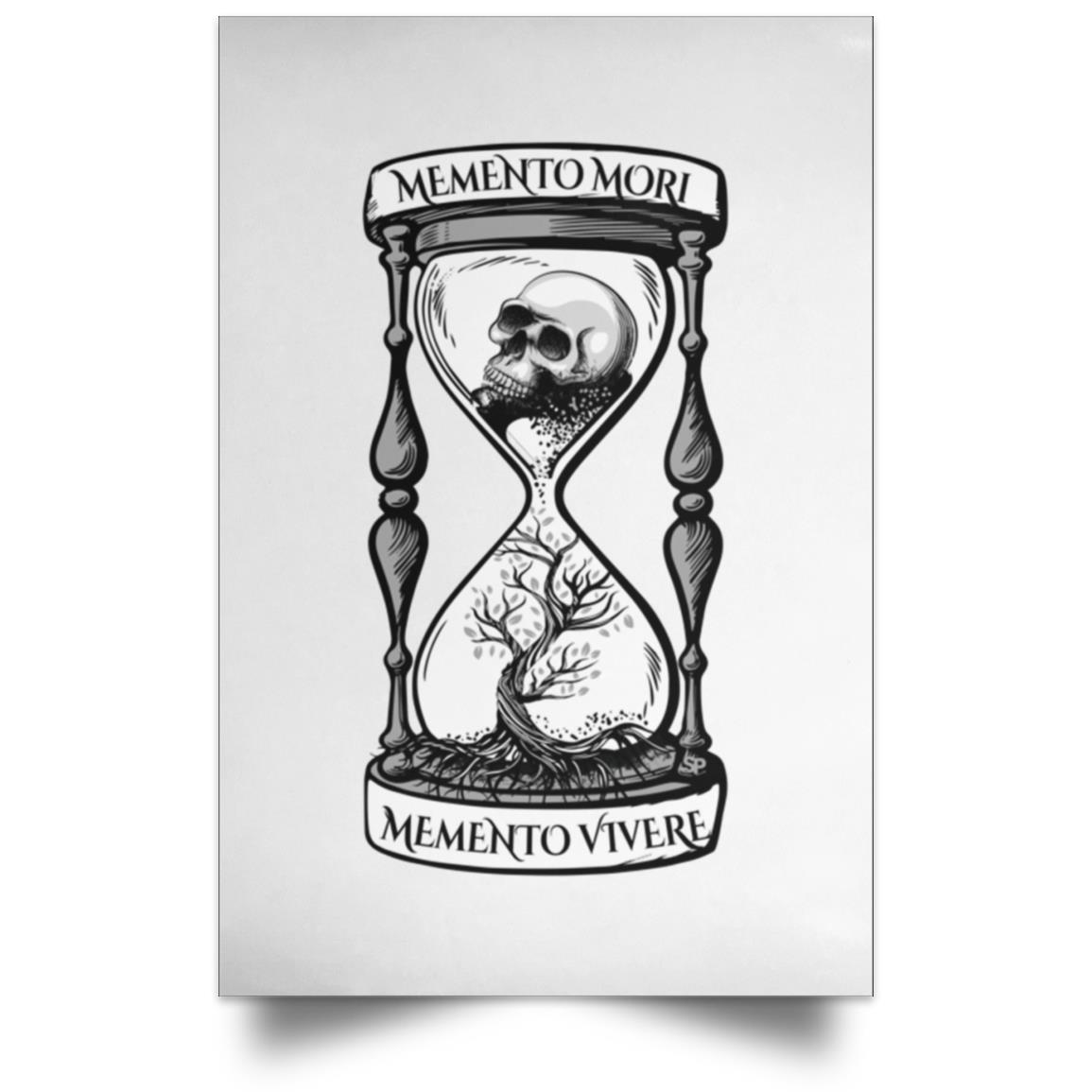
Memento Mori is a sentence that has been around for centuries, with the idea being around for much longer, all the way back to the early Stoics.
Memento Mori is Latin for "remember that you must die". This one sentence tells us a lot of things.
It tells us that life is short, that we can't say "I'll do it tomorrow" every day, because we are not guaranteed tomorrow.
It tells us not to waste our lives on meaningless things because life is too short to spend our time recklessly.
It tells us that there is a sense of urgency to our lives that we often forget: that in a split second, we can go from living to dead.
It tells us that we should be present and appreciate the experiences we are going through, because in no time they will disappear.
Memento Mori is a necessary bit of context we must continue to remind ourselves of. We are all precious, and we all have a purpose. Let us live our lives to the fullest.
What are things in life that you should be doing, but you're not? Why? Would you be okay if you hadn't done it when you died? Are you delaying your purpose? Are you letting others down?
All of the above questions are important to ask yourself to become a better person. Even if you don't believe in an afterlife or a God, your goal should be to do good. Don't let the precious currency of time run out.
Quotes Of The Week
- "Education is the most powerful weapon you can use to change the world." — B.B. King
- "You could leave life right now. Let that determine what you do and say and think." – Marcus Aurelius
- "Let us prepare our minds as if we had come to the very end of life. Let us postpone nothing. Let us balance life's books each day. The one who puts the finishing touches on their life each day is never short of time." – Seneca
- "Alexander the Great and his mule driver both died, and the same thing happened to both. They were absorbed alike into the life force of the world, or dissolved alike into atoms." – Marcus Aurelius