7 Days 7 Lessons #19

- Lesson 1: Antifragile (Growth)
- Lesson 2: The Planning Fallacy (Setting Goals)
- Lesson 3: The Google Effect (Psychology)
- Lesson 4: The Peak-End Rule (Storytelling)
- Lesson 5: Reverse Engineering (Problem Solving)
- Lesson 6: The Regret Minimisation Framework (Decision Making)
- Lesson 7: The Paradox of Choice (Psychology)
Antifragile
Stress does not always break. Instead, it often improves.
Diamonds are one of the most expensive materials to exist in the world. They are formed when immense pressure and heat are applied to carbon, eventually transforming what was once a black object into a stunning, sparkly diamond.
Diamonds are antifragile, a word coined by Nassim Nicholas Taleb in his 2012 book Antifragile: Things That Gain from Disorder.
Taleb observed there was a gap in many global languages, as they had a word for something that easily breaks under stress (fragile) and a word for something that can withstand stress (resilient), but never a word for something that improves from stress.
Although the word recently came into existence, the idea itself is not new. Friedrich Nietzsche’s 1888 work Twilight of the Idols has an incredibly popular quote:

My love life is probably the best anecdote I have. My fiancée and I have gone through ups and downs. Recognising that this is a normal thing in a relationship, we've learned from these experiences: what went well and what could've gone better. Every month, we even do a casual meeting with each other to discuss various aspects of our relationship to identify the good and the bad.
You can even look at the gym if you want another glaringly obvious example of antifragility. When doing any exercise, your muscles get tired and begin to create microshreds. These tears don't make your muscles unusable. Instead, they leave room for growth and allow the muscles to come back bigger and stronger.
It is foolish optimism to think that life will always be smooth sailing. It is equally idiotic to believe it will always be a storm.
What is certain is that life will present challenges to you, and you can either ignore them and let them beat you down, or you can learn from them and improve yourself.
Ultimately, it's clear that the things worth it in life are built under pressure. Pressure builds character, and character builds success.
The Planning Fallacy
We are awful at planning.
I cannot tell you the number of times I've seen at work, or in my spare time, an arbitrary amount of time being allocated for a piece of work.
Without being too specific and compromising any trade secrets, I recently came across a project in some part of the business. The objective was quite a big undertaking, one they had allocated multiple years to.
When I first looked at the project, I thought that it was going to be a pain to get completed.
But then it hit me. How do project managers and leaders in a business come up with a multi-year commitment for a project?
The confidence in their prediction is almost laughable. I mean, I don't even know what I'll be doing next week, let alone in a few years.
Don't get me wrong, planning is an incredibly important process in a business, and is a skill very few have.
But in general, we suck at planning!
Another example I love bringing up. The absolute FAILURE of HS2, a high-speed train project Britain was planning on doing.
In 2009, HS2 was envisioned. They wanted to connect areas of the UK at incredible speeds.
It would connect London with Leeds and Manchester, where it would allow commuters to travel between these cities within an hour. They estimated it would cost £37.5 billion.
In 2013, that figure had gone to £46 billion, and in 2015 it went to £55 billion. A leaked government review in 2020 stated it could reach up to £106.6 billion.
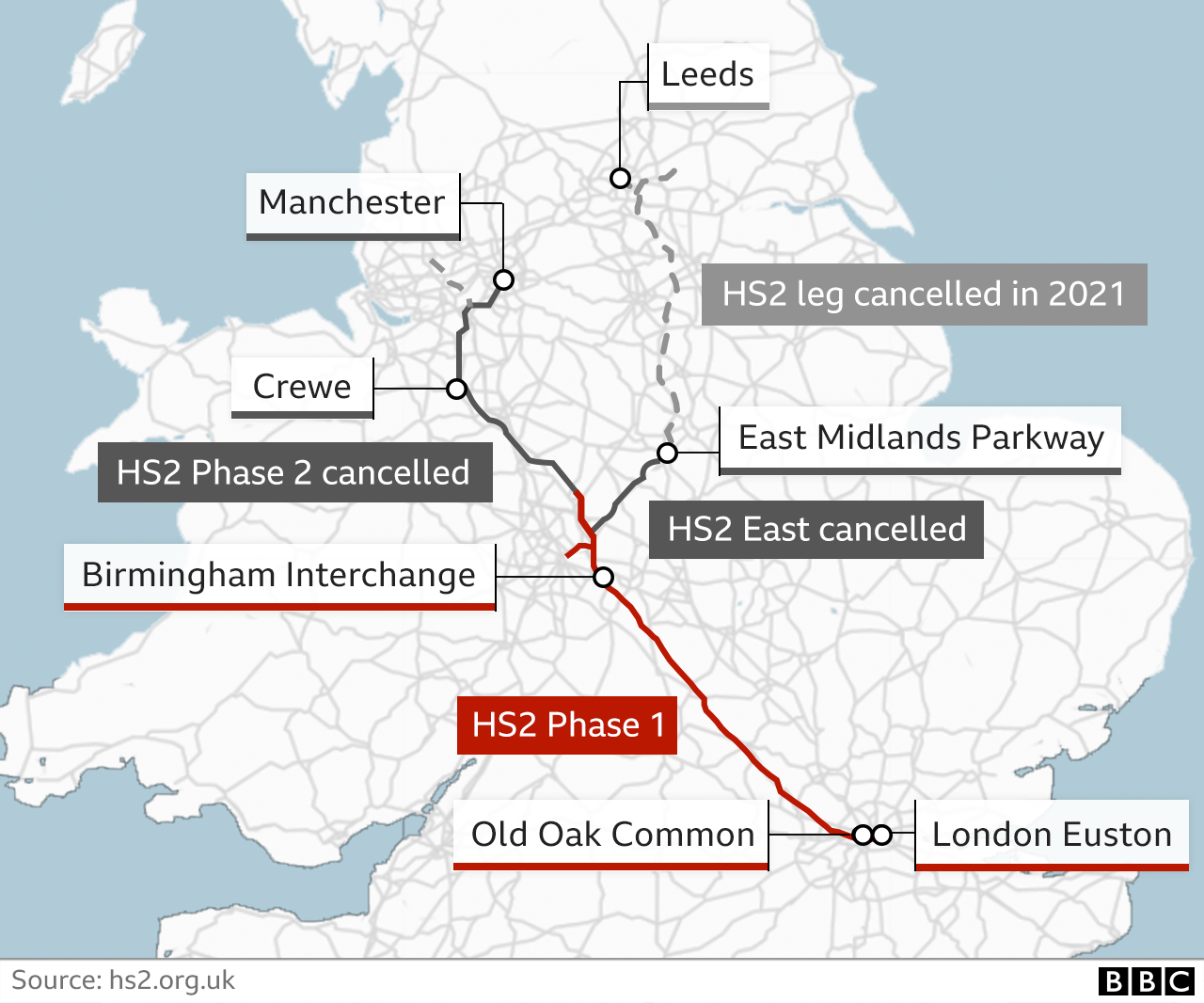
It doesn't end there! When they realised the costs were unsustainable, they scrapped the connections going to Manchester and Leeds, essentially only making a high-speed connection to Birmingham. Who even wants to go to Birmingham!?
Examples aside, studies also back this fallacy.
In 1994, students were asked to estimate how long it would take to finish their psychology thesis. On average, students said it would take 33.9 days, with their worst-case scenario being 48.6 days. In reality, it was 55.5 days. No wonder students are pulling all-nighters when they realise they have underestimated how long it would take to complete an assignment.
Our inability to plan accurately is called the Planning Fallacy, and it was coined by Daniel Kahneman and Amos Tversky in 1979.
There are three main reasons why we are so poor at planning.
- The Inside View – We tend to focus on what we can control and imagine things going to plan. This is never the case, and there will be plenty of times when things are out of our control.
- Optimism Bias – When thinking about the future, we are incredibly optimistic. Therefore, when we plan in the future, we also optimistically plan our deadlines.
- Motivated Reasoning – We tend to unconsciously create plans that confirm the project we are working on is feasible. We force a square peg into a circular hole.
There are two things I do to make sure I complete a task on time. Firstly, I aim to complete the deadline one week earlier. Secondly, that extra time before the deadline is overflow time.
Building buffers into your deadlines and planning at best-case makes it seem like you've worked faster than you anticipated, but at worst-case means you get the job done.
Finally, being a pessimist is very helpful; overestimating your deadline is always better than underestimating it.
The Google Effect
Our brains forget things we can easily look up.
Mobile phones are wonderful pieces of technology. They provide so much utility, such as allowing us to access the internet, keeping us in contact with our families, and even capturing moments in our lives with pictures.
However, one thing is clear: the ability to store information on these devices or access it from these devices has definitely made us worse at remembering certain things.
Let's take phone numbers as an example. If you ask any adult who was born before the time of digital phones, you will know that they seem to remember a vast amount of phone numbers. They didn't have the luxury of a digital phonebook with them every second of their lives, so it was imperative to remember phone numbers in case they ever needed one.
I mean, before I got my phone, I remembered my mum's phone number off by heart in case I needed to call her from the home telephone line.
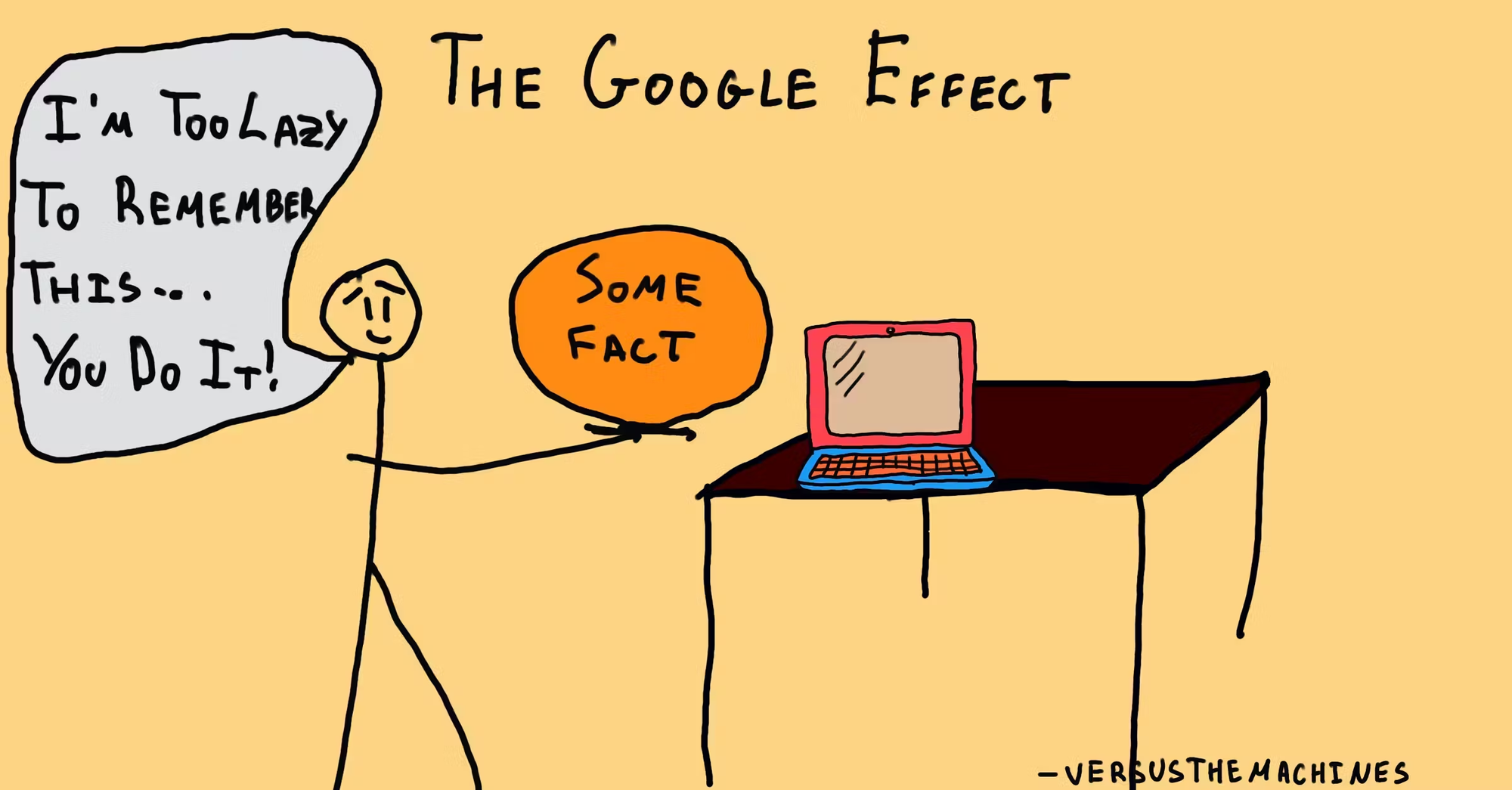
Known as the Google Effect, this tendency to forget information that we can easily access is accurately named.
Google has meant that all the questions we might have can be answered in one simple search result.
I mean, what's the point of remembering a car route if I can just set the destination on my sat nav? What's the point of remembering what the definition of sanguine is when I can just look it up instantly every time it gets used?
A study in 2011 illustrated that if something can be quickly accessed, it can also be quickly forgotten.
In the experiment, the cohort was told to write trivia statements into a computer. Half of the cohort was told that the statements would be saved, and half were told the statements would be deleted.
Those who believed the statements would be deleted had better recall than those who thought they would be saved.
In fact, a follow-up experiment showed that participants would be better at remembering the location of where the data would be saved, rather than the data itself.
During the Industrial Revolution, our labour was replaced. In the internet era, our memory was offloaded. Will we see this trend happen with Artificial Intelligence? Will we offload the ability to think and reason to these machines? Become like all other animals, who don't seem to have the same capability to think as we do?
I don't think it's necessarily a bad thing that we don't need to remember mundane pieces of information. In fact, it means we leave room to remember more important pieces of information, ones deemed more critical than others.
However, there is a line that must not be crossed. Memory is an important skill to have, and one that must be valued. We don't want to fall into the trap of offloading the knowledge about something. That is foolish and will leave you in a perpetual cycle of learning the same things over and over again.
Instead, we want to keep our memory sharp and want to be actively using it rather than blindly offloading it to technology.
The Peak-End Rule
When telling a story, there are only two moments that matter: The peak and the end.
Let me ask you to remember a recent film you watched. Can you remember it in vivid detail? Okay, what about a film you watched a few years ago? What details do you remember first?
Most people's answers to those questions are their favourite moment and how they felt about the ending.
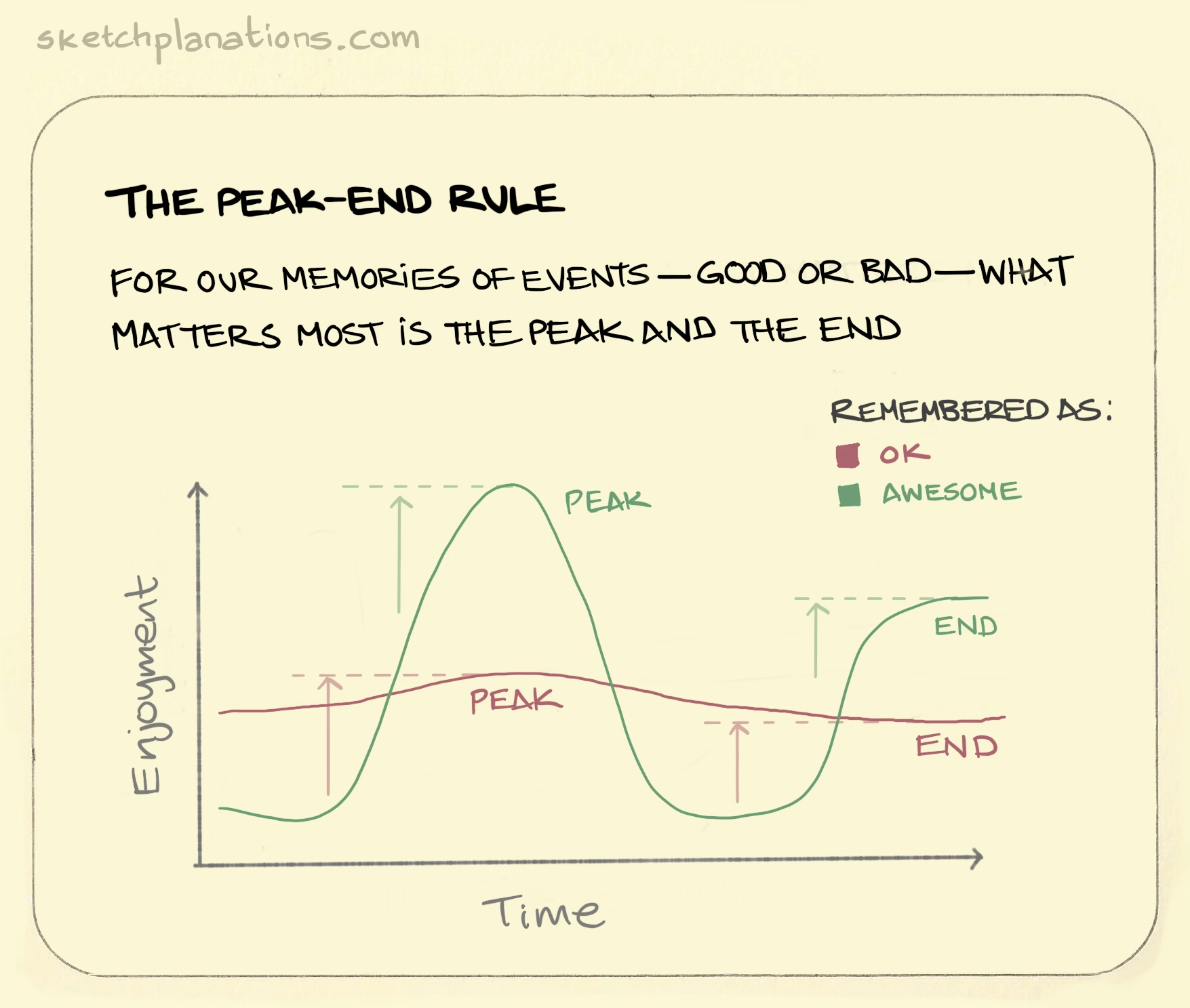
This is known as the Peak-End Rule, which was first identified by Daniel Kahneman, alongside some of his peers. The rule essentially states that the ability to recall an experience and your enjoyment of it is broken down into two factors. What was your favourite moment, and how did it end?
Many other rules try to formulate what people might recall from an experience, including other factors such as duration, how it started, and the worst moment.
However, according to one meta-analysis study on this rule and many others alike, it found that the peak-end rule performed the best.
Anecdotally, this holds up in my life. When I think back to one of my favourite trips of recent times, a double date to Majorca, I remember a lot of my favourite moments such as going on walks in the warm night air, a very fun waterpark experience, and swimming in the sea, but I also remember how it ended, a trip on a coach to an airport followed by a smooth plane journey and a train back home.
Unfortunately, however unbiased we want to be, it seems like we have the natural tendency to let our favourite moments and the end dictate how good an experience was.
I've spoken about the importance of storytelling in life. It helps build friendships, advance your career, and make you happier in life in general.
This rule should influence how you tell a story. Identify the best moment, and make sure the ending is fantastic. Focus on those two first, and then everything else will fall into place.
Reverse Engineering
Working backwards is the best way to know what steps need to be taken for success.
I don't know about you, but the way I plan a task is by envisioning its completion and working backwards from it.
For example, the other day I was thinking of creating a video game as a little Hackathon. It wouldn't be anything fancy; it was to stress-test how good AI is at making games and to be used as a creative outlet. I thought about the finished product, then thought about how I would design each character and level, how I would program everything and continued breaking these bigger tasks into smaller and smaller, more actionable goals.
Coincidentally, this is how most companies set out their goals for the year. The leaders of a business will envision an abstract goal they want to complete, such as increasing revenue by 20%. Then the managers reporting to these leaders will set smaller tasks from that desired goal, until the low-level employees set their own Key Performance Indicators (KPIs) to achieve the ultimate goal.
The technique of working backwards from the final goal is called Reverse Engineering, a term commonly used in fields such as computer science, but the name describes it well.

Stephen Covey's quote sums it up well. Understanding the bigger picture will allow you to start painting it.
This week, I've already highlighted the importance of planning and how hard it is to pick up. Having multiple techniques that can help you achieve mastery in planning is incredibly valuable.
Working backwards allows you to visualise the complete project, understand the different challenges you may face, plan for them, and break up big goals into smaller tasks.
The Regret Minimisation Framework
Regret is a powerful motivator. Identify it and squash it.
Our future selves are drowning in regret right now. Maybe we know why, but sometimes we don't realise it until it's too late.
Maybe it's the person who was going to start a business they were passionate about, but ended up second-guessing themselves and sticking to their 9-5.
Maybe it's the guy who kept telling himself that he would take care of his health later every single time, and now it's too late to do anything.
Maybe it was the couple that waited too long to have a family.
Regret is one of the most moving emotions anyone can feel.
An emotion that you only feel when it's too late. All you can do is hopelessly scratch the door of the opportunity that has closed and will no longer open.
Jeff Bezos, the founder of Amazon, used to work at D.E. Shaw, a hedge fund, in 1994. One day, he decided to leave his comfortable job and start his business. Amazon.
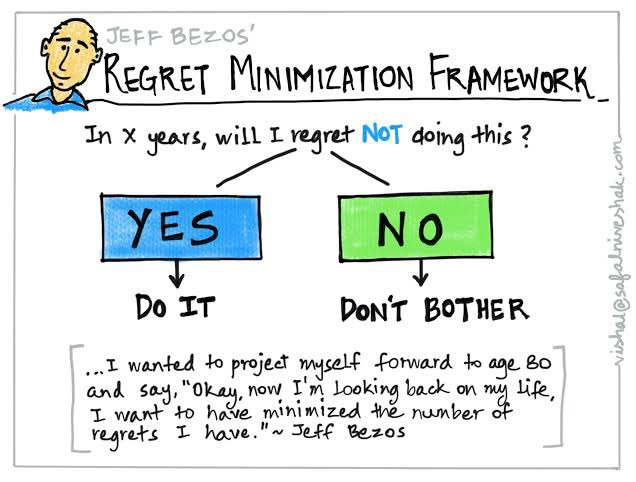
He contextualised his decision, put himself in the shoes of his future self, and asked himself, what choice would I regret not making? He identified that choice and then made it.
He gave up his stable salary and job and went into the brutal world of business. And won.
This technique is known as the Regret Minimisation Framework, and has helped millions of people make the decision they know their future self would have made.
Jeff Bezos's story is not one that many people will find similarities with, but even if he had failed like most businesses do, he would not be living a life of regret, because he put his best into it.
The framework helps you ignore the short-term discomfort, fear, social pressure, and paralysis that you might have when making a decision. These feelings are the reasons why most people make the wrong decision.
It also helps you identify the decisions that would make you regret life the least. It's an all too common story for those on their deathbeds to regret a lot of their decisions; they are wise, and we should listen to them.
The Paradox of Choice
Do you overthink? Maybe it's because there are too many options.
You walk into a Starbucks. What is your go-to drink of choice?
How long did you take to decide on that? Do you ever change from that drink? Why not?
Let me answer all these questions.
My go-to drink is a latte, either iced or not, based on the temperature outside. I rarely diverge, but if I do, I go for an iced brown sugar oatmilk shaken espresso ( a bit of a mouthful). I don't change my drink because there are too many options for me to consider, and I'm happy enough with what I have.
One of my colleagues goes for an americano, and I have never seen her go for anything else.
I can't speak for her, but for me, it's just too much effort to find a different drink that fits my taste buds from the wide selection of choices I could be making. I'm happy with what I've got, and that's all that matters for me.
The same is true for most people. Oftentimes, when you go to a restaurant, or a coffee shop, or a cocktail bar, you just need a drink you like, not thousands of different options.
If you had a list that spanned multiple A4 sheets, you would end up overthinking and regretting a choice if it was not up to standard.
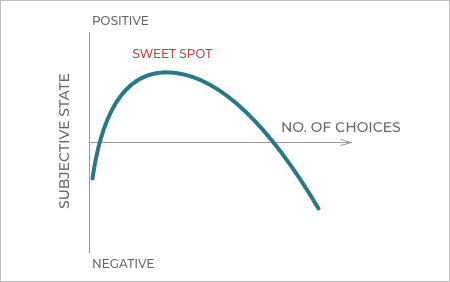
The Paradox of Choice, popularised by Barry Schwartz in his 2004 book The Paradox of Choice: Why More is Less, speaks to the idea that we don't actually want more choice after a certain threshold. All it would do is create anxiety, decision fatigue and dissatisfaction.
In fact, this idea is so popular that it has changed the business landscape. Most of the best businesses put this into action, and studies back this up.
Let's take the study that popularised this rule.
In one study, the scenarios were played out. One day, a 24-jam display was set up. On the second day, there were only 6. During this time, customers could have a taster of each jam. Although more customers stopped to have a look at the bigger display, the one that received more sales was the display with less jam.
Customers were fascinated by the number of jams on display, but when it came to making a decision, they couldn't and walked away.
If you're a business, a good amount of options means you can keep costs low, quality high and keep customers satisfied.
If you're looking to apply this to your everyday life, remember that looking at every single option for any situation is not always the best idea and can lead to a life of regret. Get a few options, and work from there.
Quotes Of The Week
- "If you don't like something, change it. If you can't change it, change your attitude. Don't complain." – Maya Angelou
- "What does not kill me makes me stronger" – Friedrich Nietzsche
- "Begin with the end in mind." – Stephen Covey
- "Success is not final, failure is not fatal: it is the courage to continue that counts." — Winston Churchill